ADHD Brain Fog: 9 Ways to Clear It (and What's Really Causing It) in 2026
By Soothfy Team ·
ADHD brain fog makes thinking slow and scattered. Learn what causes it, how it differs from tiredness, and 9 research-backed ways to clear it.You sit down to work. You open the document. And then… nothing. The words blur together. You reread the same email three times and still couldn't tell someone what it said. You know exactly what you need to do, but your brain feels like it's wading through wet cement.
Ten minutes later you're somehow on your phone, and you don't remember picking it up.
If you have ADHD, you probably know this feeling well. There's a name for it: ADHD brain fog. It's one of the most frustrating parts of adult ADHD, because nobody can see it. You're not lazy, and you're not "just tired." Your brain is struggling to hold information, filter out noise and switch gears, and that's a real, well-studied problem with real fixes.
This guide is for you if:
- You have ADHD (or suspect you do) and your thinking often feels slow or cloudy
- You've slept "enough" but still can't think straight
- You want practical fixes, not "just try harder"
- You want to know when brain fog might be something else
Quick answer: how do you clear ADHD brain fog?
- Brain-dump first: write every open loop on paper to free up working memory.
- Anchor your wake time: the same time every day is the strongest lever for better sleep.
- Move for 10–20 minutes: even one exercise session improves focus and self-control.
- Drink water and eat: dehydration beyond 2% of body weight measurably hurts attention.
- One tab, one task: constant switching is one of the fastest ways to fog up.
If fog is new, sudden or getting worse, see a doctor. It can have other causes.
1. What Is ADHD Brain Fog?
ADHD brain fog is an informal term for periods of slow, cloudy or scattered thinking in people with ADHD: trouble holding information in mind, following a train of thought, starting tasks or finding words. It isn't a separate diagnosis, but it's closely tied to how ADHD affects attention, working memory and alertness.
You won't find "brain fog" in the DSM-5, the manual clinicians use to diagnose ADHD. That doesn't make it less real. It's simply the everyday name for what happens when several well-studied ADHD difficulties pile up at the same time.
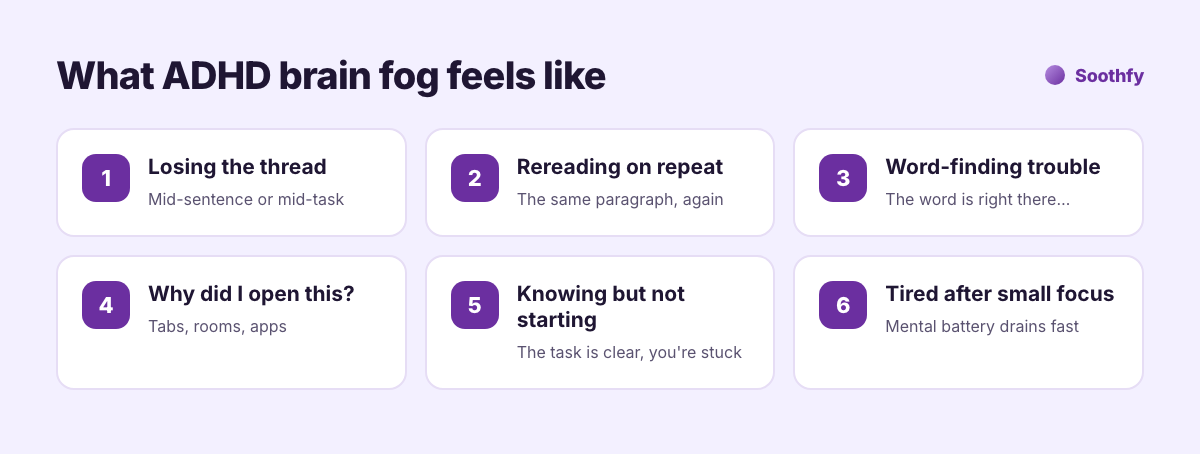
- Losing the thread mid-sentence or mid-task
- Rereading the same paragraph again and again
- Reaching for a word that's "right there" but won't come
- Forgetting why you opened a tab, an app or a door
- Knowing exactly what to do but being unable to start
- Feeling mentally drained after a small amount of focus
- Everything feeling equally urgent, or equally pointless
Example: You need to reply to one simple email. You open it, read it, open a second tab to check a date, notice a message, reply to that instead, and 40 minutes later the original email is still unanswered, and you feel exhausted.
If this sounds familiar, you might also relate to 7 Things People With ADHD Do When They're Overwhelmed.
ADHD brain fog vs. normal tiredness
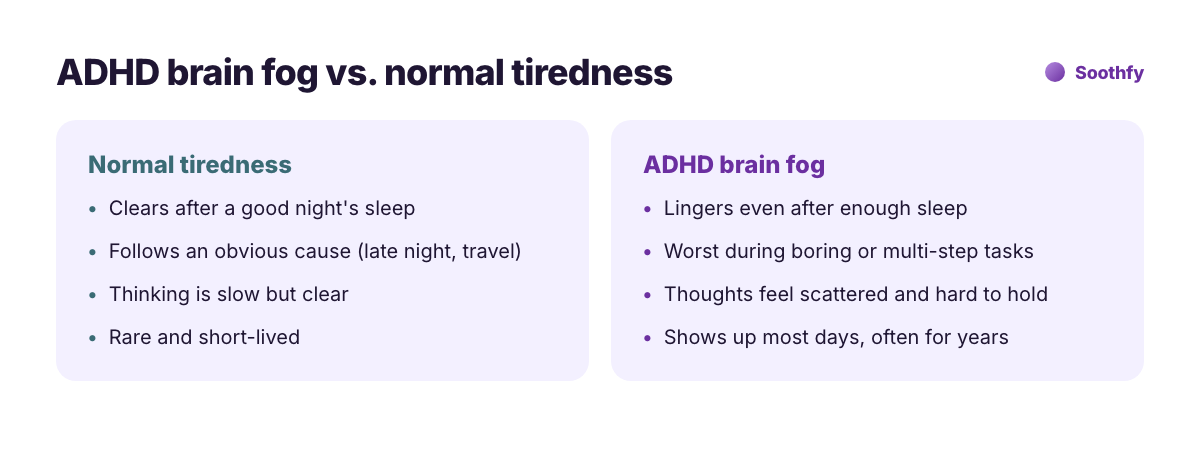
Everyone feels foggy after a bad night. The difference with ADHD brain fog is that it often sticks around even when you've slept enough, shows up most days, and gets noticeably worse with boring or multi-step tasks, then lifts when something is urgent or interesting.
2. Is It ADHD Brain Fog or Cognitive Disengagement Syndrome?
There's a lesser-known condition that looks a lot like brain fog: cognitive disengagement syndrome (CDS). Until 2023, it was called sluggish cognitive tempo. CDS describes a pattern of excessive daydreaming, mental fogginess, slowed thinking, staring or "zoning out," and daytime drowsiness.
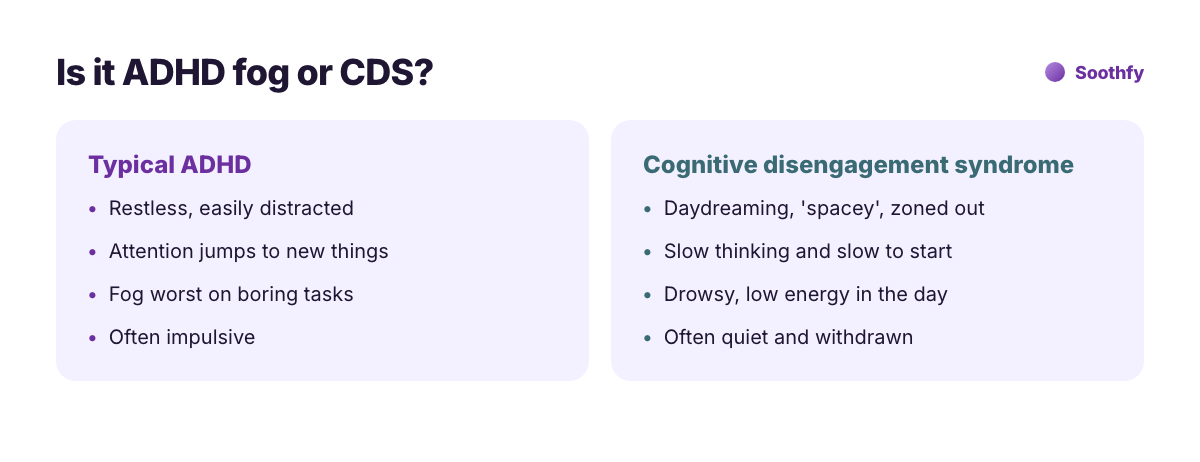
Why it matters: if your fog feels more spacey and slow than scattered and restless, mention CDS to your clinician. It can change what strategies and treatments make sense. This short explainer from Understood covers it well:
3. What Causes ADHD Brain Fog? (7 Main Causes)
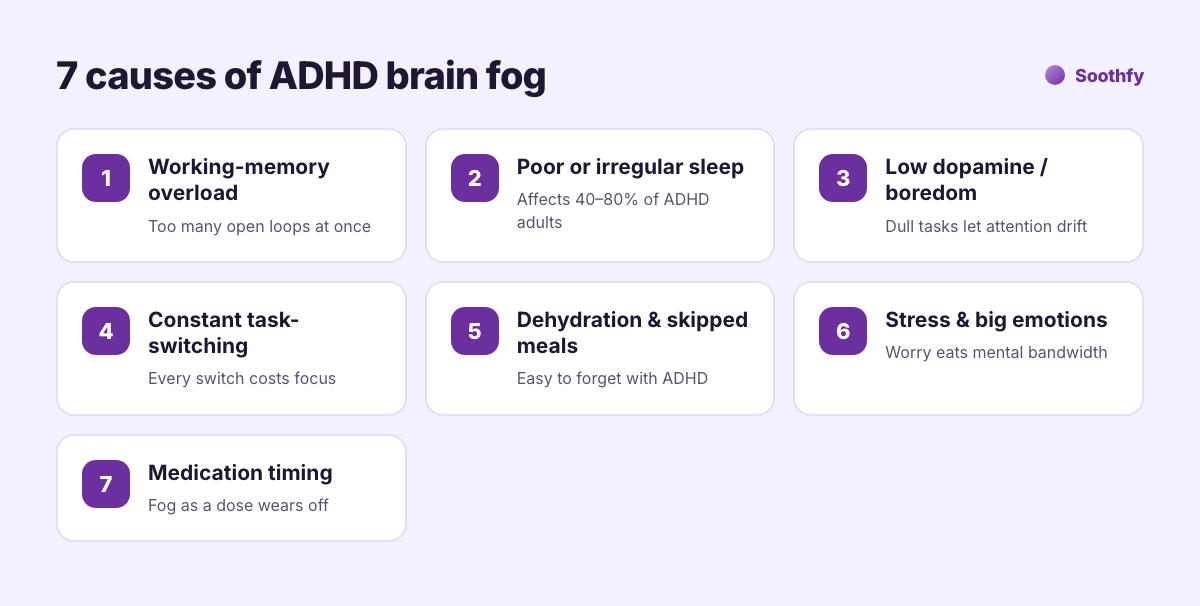
Brain fog rarely has a single cause. It's what happens when ADHD's baseline challenges stack up with a few everyday "multipliers."
Cause 1: Working-memory overload
Every unfinished task, reminder and worry you're "keeping in your head" takes up space in working memory. With ADHD that space is smaller and leakier, so it fills up fast. When it's full, new information has nowhere to go, and everything feels cloudy. This is also why ADHD brains struggle to start tasks.
Cause 2: Poor or irregular sleep
Many adults with ADHD have a naturally delayed body clock: wide awake at midnight, foggy at 9 a.m. If your fog is worst in the morning, sleep is the first place to look. See ADHD and Sleep: 7 Strategies to Fix the Sleep Problems Nobody Talks About and the data in ADHD and Sleep Statistics 2026.
Cause 3: Low dopamine and boredom
That's why fog tends to roll in during dull tasks (spreadsheets, forms, admin) and clears the moment something is urgent, new or interesting. It's also the flip side of ADHD hyperfocus.
Cause 4: Constant task-switching
Every time you jump between tabs, messages and tasks, your brain has to reload what you were doing. With ADHD that reload is slower and leakier. A morning of constant switching can leave you feeling like you worked all day while getting nothing done.
Cause 5: Dehydration and skipped meals
ADHD makes it easy to forget water and meals, especially during hyperfocus or when stimulant medication suppresses appetite. For more on the food side, read ADHD and Overeating.
Cause 6: Stress and big emotions
Worry, frustration and shame use the same mental resources you need for thinking. A stressful morning can fog up the whole afternoon. If emotions often hijack your focus, see ADHD Emotional Dysregulation.
Cause 7: Medication timing
Some people feel foggy or flat as a stimulant dose wears off, often in mid-to-late afternoon, a pattern sometimes called medication rebound (Understood). Doses and timing that aren't quite right, or effects on sleep and appetite, can cause fog indirectly. This is something to track and raise with your prescriber, never to fix by changing your dose yourself.
Track Your Brain Fog Patterns Free on Soothfy4. When Does Your Fog Hit? Match the Fix to the Time
Most guides give one list of tips. But fog at 8 a.m. usually has a different cause than fog at 3 p.m. Use this table to match the fix to your pattern:
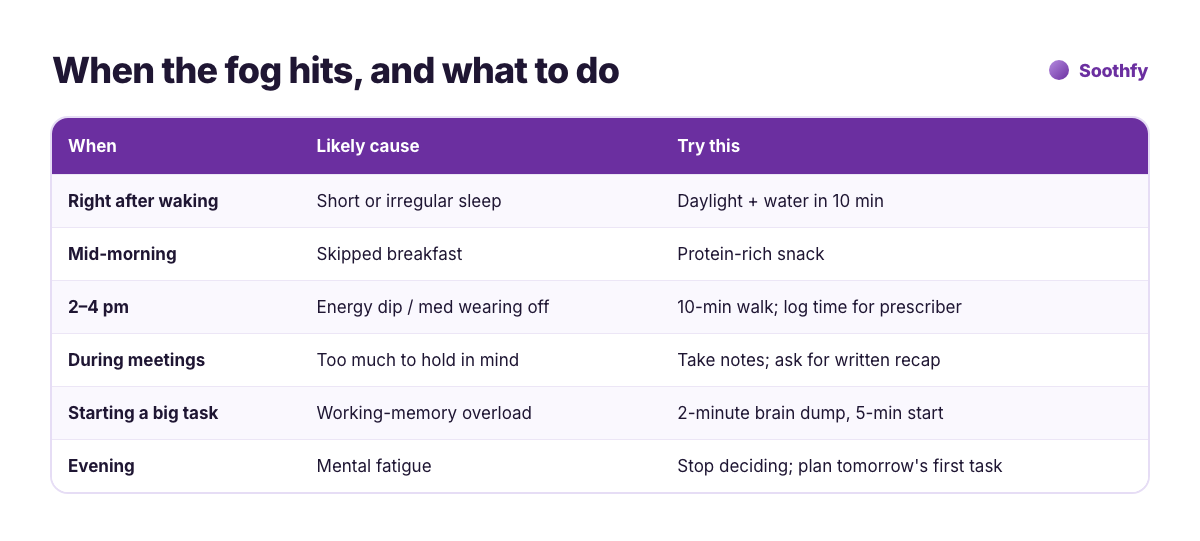
| When the fog hits | Likely cause | Try this |
|---|---|---|
| Right after waking | Short or irregular sleep | Daylight and water within 10 minutes; same wake time tomorrow |
| Mid-morning | Skipped breakfast | A protein-rich snack |
| 2–4 p.m. | Energy dip or medication wearing off | 10-minute walk; note the time for your prescriber |
| During meetings | Too much to hold in mind | Take notes; ask for a written recap |
| Starting a big task | Working-memory overload | 2-minute brain dump, then a 5-minute start |
| Evening | Mental fatigue | Stop making decisions; write tomorrow's first task |
5. How to Clear ADHD Brain Fog: 9 Ways That Work
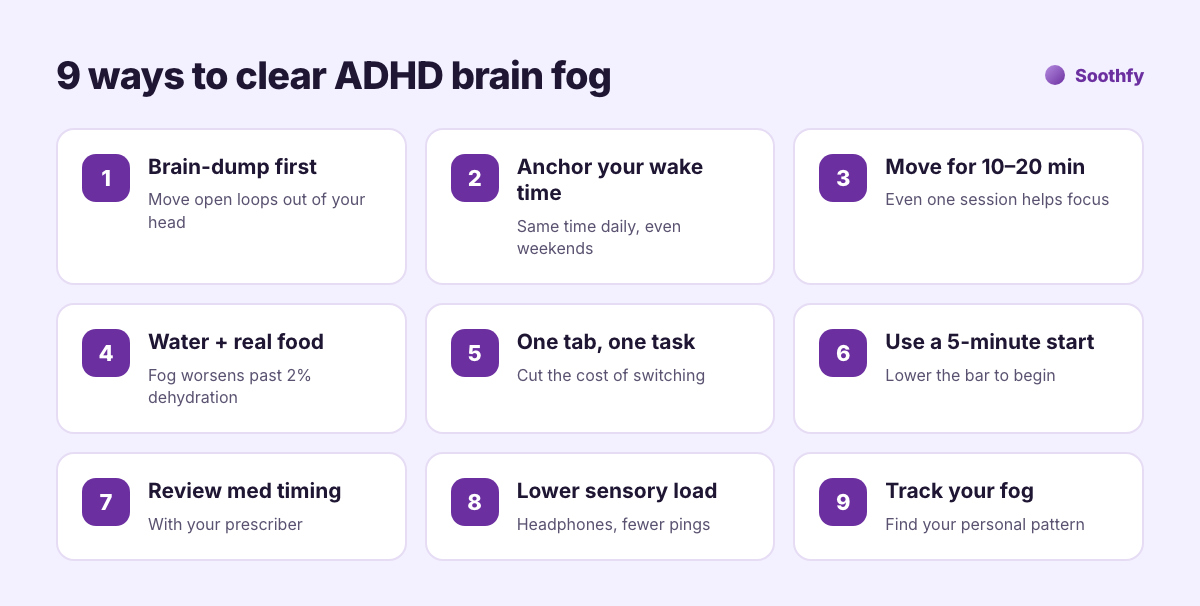
1. Do a 2-minute brain dump
How to do it:
- Set a 2-minute timer.
- Write everything on your mind: tasks, worries, random ideas. Don't organize.
- When the timer ends, circle one thing to do next.
- Everything else stays on the page, safe and out of your head.
2. Anchor your wake time (not your bedtime)
Forcing an early bedtime rarely works with a delayed ADHD body clock. A consistent wake time, every day including weekends, is the most reliable way to reset your rhythm.
- Pick a wake time you can realistically keep 7 days a week.
- Get daylight within 30 minutes of waking.
- Let bedtime drift earlier naturally over 1–2 weeks.
Pair it with an easy start to the day: ADHD Morning Routine: How to Actually Start Your Day.
3. Move for 10–20 minutes
- A brisk walk, stairs, jumping jacks or a short bike ride before a hard task.
- Only have 5 minutes? Use 5.
- Best timing: right before the task you're dreading, or just before your afternoon dip.
4. Drink water and eat something real
- Keep a filled water bottle in sight. Out of sight is out of mind with ADHD.
- Tie drinking to an existing habit: every time you open your laptop, take three sips.
- Eat breakfast, even something small, especially if medication lowers your appetite later.
What about supplements? Omega-3 is the most studied. A meta-analysis of 7 trials in children and teens with ADHD found modest improvements in symptoms and attention-related measures (Chang et al., Neuropsychopharmacology, 2018). Evidence in adults is more limited, so talk to your doctor before starting any supplement.
5. One tab, one task
- Close everything except what you need for the current task.
- Put your phone in another room, or on Do Not Disturb for 25 minutes.
- Batch messages into 2–3 set times a day instead of answering instantly.
6. Use a "5-minute start"
Fog often shows up as the inability to begin. Instead of committing to finish, commit to 5 minutes. Starting is usually the hardest part, and the fog often lifts once you're moving. More tactics in How to Break ADHD Task Paralysis in Under 5 Minutes.
7. Review your medication timing with your prescriber
- For one week, write down when you take your dose and when fog hits.
- Note sleep and appetite changes too.
- Share the log with your prescriber. Don't adjust your dose on your own.
8. Lower your sensory load
Noise, clutter, bright screens and constant pings compete for the same attention you need to think. Noise-cancelling headphones, a clear desk surface and fewer open apps can make a noticeable difference, especially in open-plan offices.
9. Track your fog to find your pattern
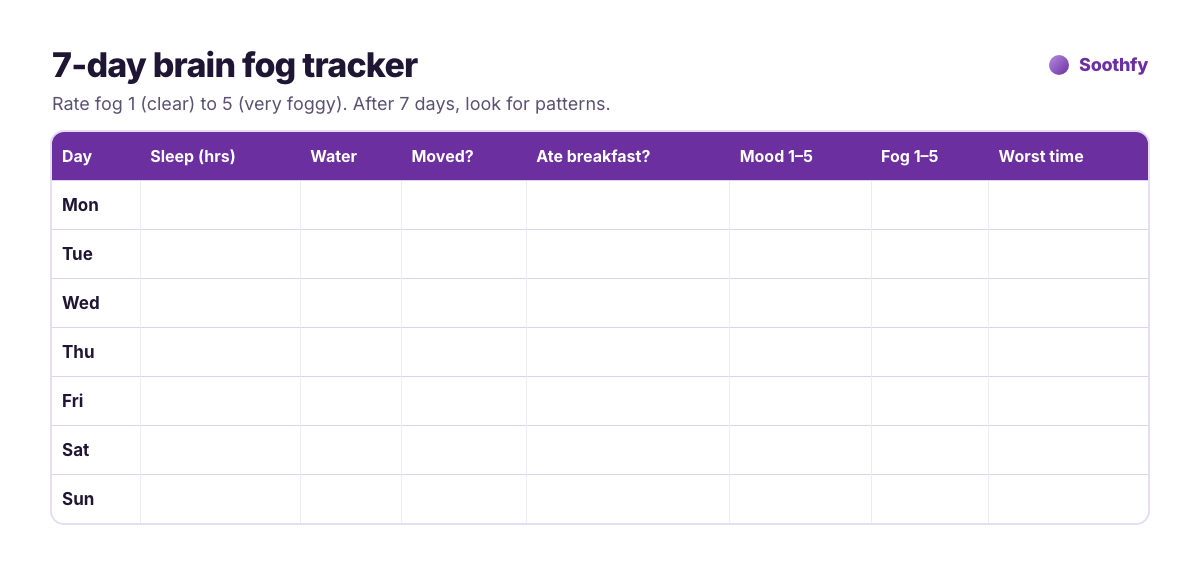
Brain fog feels random, but it rarely is. After 1–2 weeks of simple tracking, most people spot clear patterns, like "fog is always worse after less than 6 hours of sleep" or "Monday afternoons are the worst." Use the free tracker below, or track it in an app.
6. The 5-Minute Brain Fog Reset
When you're foggy right now and need to get something done, run this:
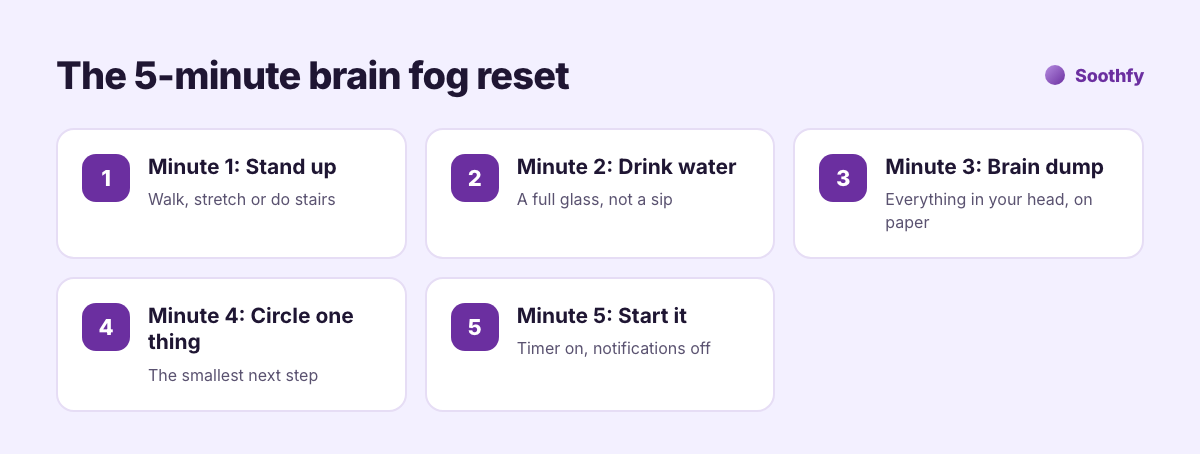
- Minute 1: Stand up. Walk, stretch or do a flight of stairs.
- Minute 2: Drink water. A full glass, not a sip.
- Minute 3: Brain dump. Everything in your head goes on paper.
- Minute 4: Circle one thing. The smallest possible next step.
- Minute 5: Start it. Timer on, notifications off.
7. Free Printable: 7-Day Brain Fog Tracker
Print this or copy it into your notes app. Fill in one row per day, then look for patterns at the end of the week. Share it with your doctor if you're discussing ADHD, sleep or medication.
8. A Simple Anti-Fog Daily Routine
You don't need all 9 fixes. Start with one small anchor habit for each part of your day:
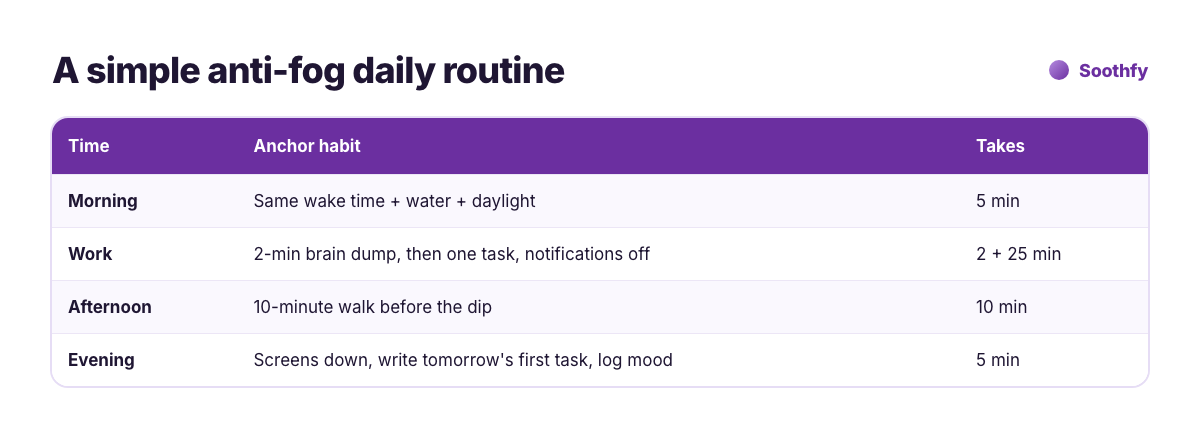
Consistency beats intensity: four tiny habits done daily work better than a perfect routine abandoned on day four. This Morning / Work / Evening structure is exactly how Soothfy's 30-day plans are built.
9. Quick Self-Check: Is It ADHD Brain Fog?
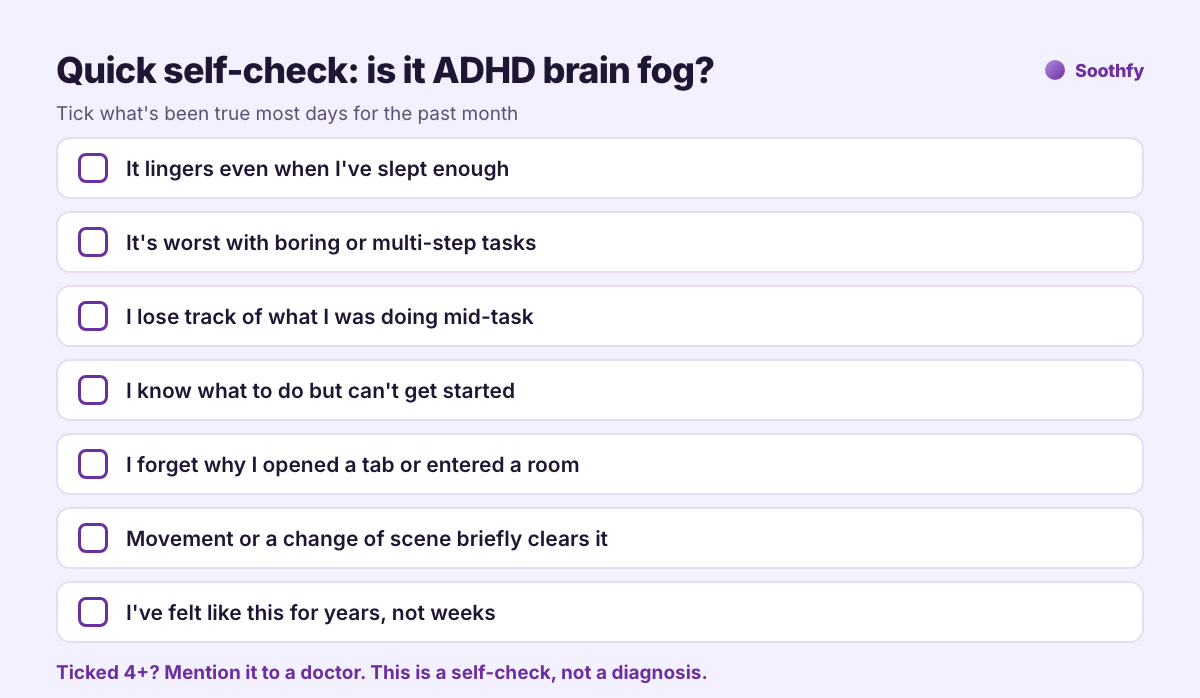
If you ticked four or more, it's worth mentioning to a doctor, especially if you've never been assessed for ADHD. About half of U.S. adults with ADHD were diagnosed in adulthood (CDC MMWR, 2024). Many ADHD signs in adults are easy to miss; see 12 ADHD Symptoms in Adults That Doctors Often Miss.
10. When Brain Fog Might Be Something Else
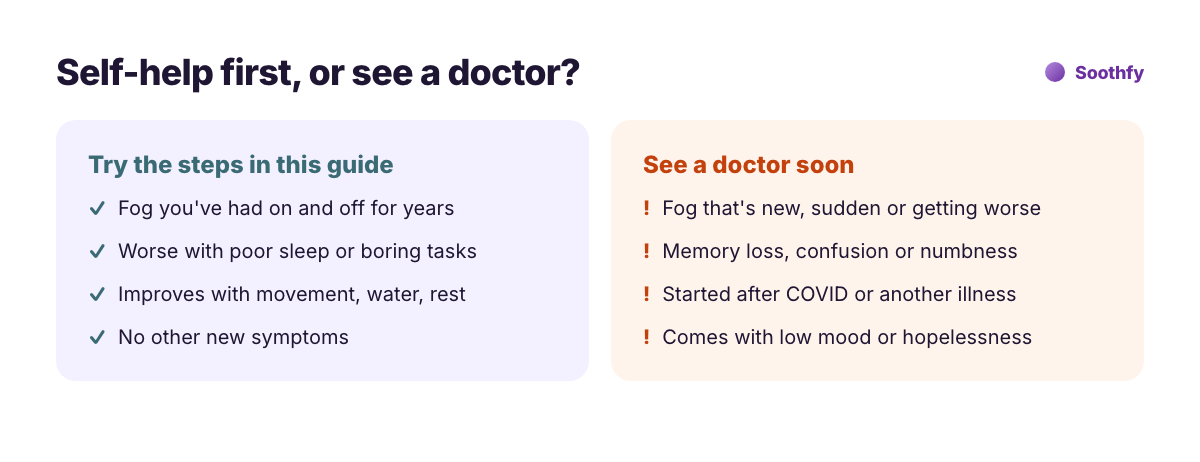
Not all fog is ADHD. Talk to a doctor if your brain fog:
- Is new, sudden or steadily getting worse
- Comes with memory loss, confusion, numbness, severe headaches or vision changes
- Started after an illness such as COVID-19
- Comes with unexplained weight change, feeling cold or constant exhaustion
- Comes with low mood, hopelessness or loss of interest in things you enjoy
Thyroid problems, anemia, sleep apnea, depression, hormonal changes (such as perimenopause) and medication side effects can all cause brain fog and are worth ruling out. Depression often overlaps with ADHD; see ADHD and Depression Statistics 2026.
11. Tools That Help With ADHD Brain Fog
Soothfy: best for building daily anti-fog habits
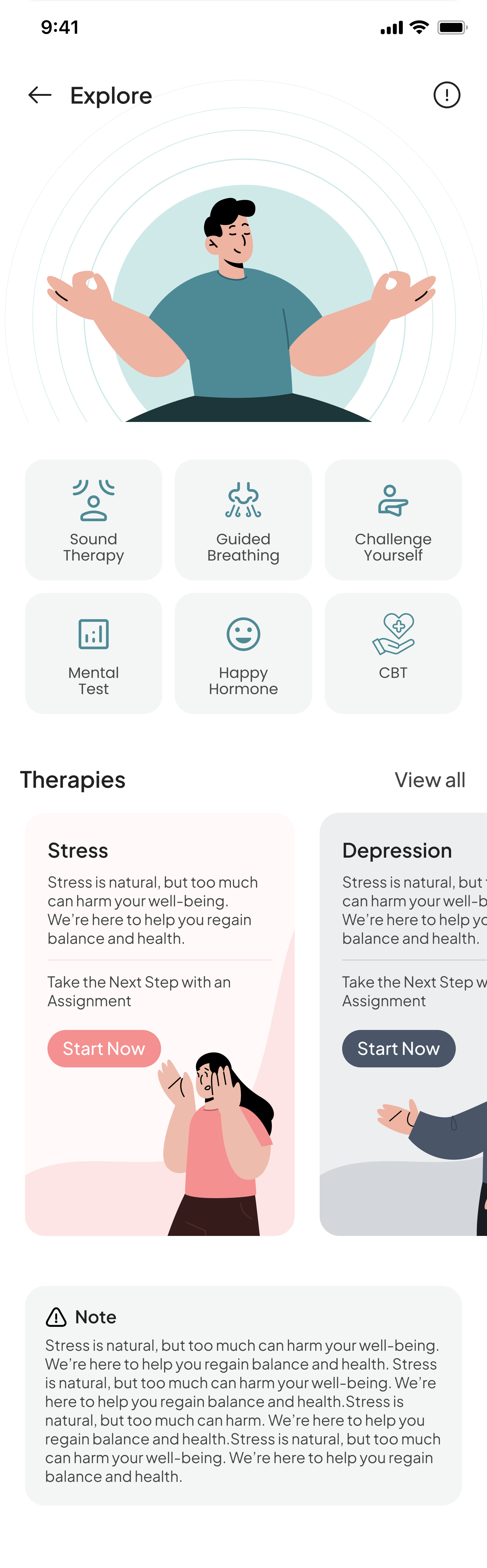
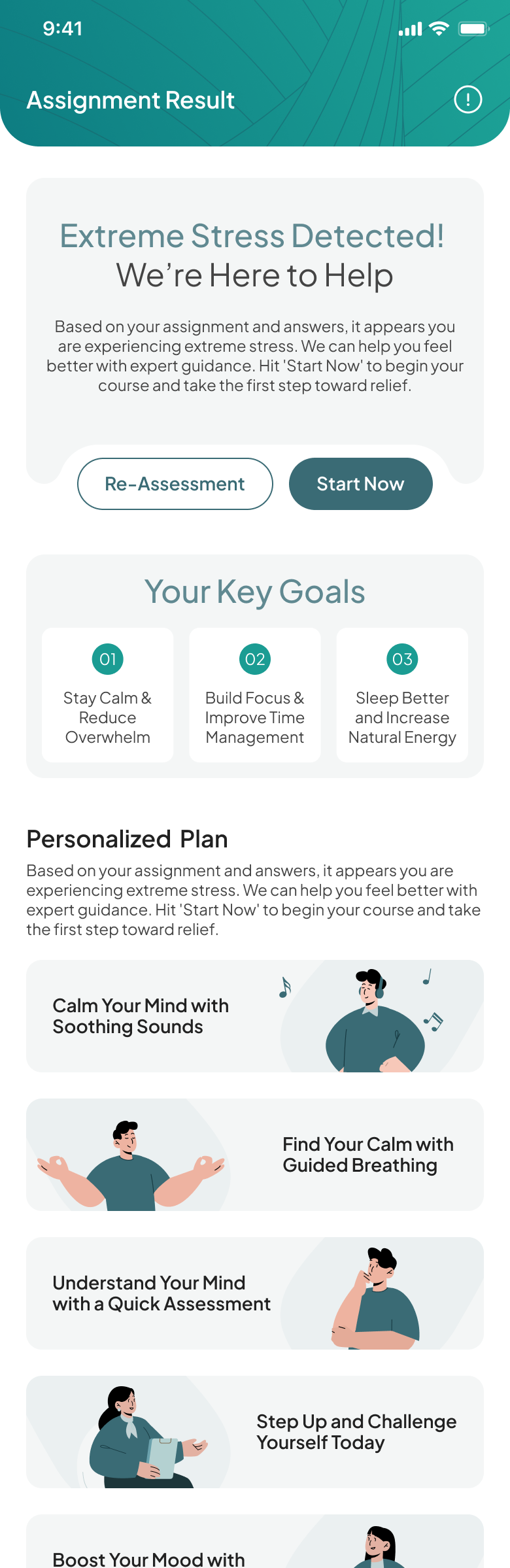
Soothfy turns the routine above into a personalized 30-day plan. After a short assessment, you pick three daily anchor habits (morning, work and evening), and Soothfy adds:
- Mood and energy tracking to spot your fog pattern
- A daily Brain Score (0–100) based on your anchors, mood, journaling and relief tools, so you can see which habits line up with clearer days
- Short CBT-based activities that keep things fresh without overwhelm
- Quick relief tools and sound therapy for foggy, overwhelmed moments
- Streaks with a grace period, so one bad day doesn't wipe your progress
Soothfy is a daily support tool. It doesn't diagnose or treat ADHD and works best alongside care from a qualified professional.
Try Soothfy Free for 7 DaysGoblin.tools: best for breaking down tasks
A free set of small AI tools built for neurodivergent people. Its "Magic ToDo" breaks a big, foggy task into small steps. Useful when you can't figure out where to start.
Focusmate: best for body doubling
Book a video co-working session with another person and work side by side. Having someone "there" helps many ADHD adults push through foggy periods.
Daylio: best for simple mood tracking
A quick micro-diary for logging mood and activities with a few taps. Good if you only want tracking. For more options, see Best ADHD Apps in 2026.
Key Facts About ADHD Brain Fog
- Brain fog isn't an official ADHD symptom, but it reflects well-documented ADHD difficulties with working memory, attention and arousal.
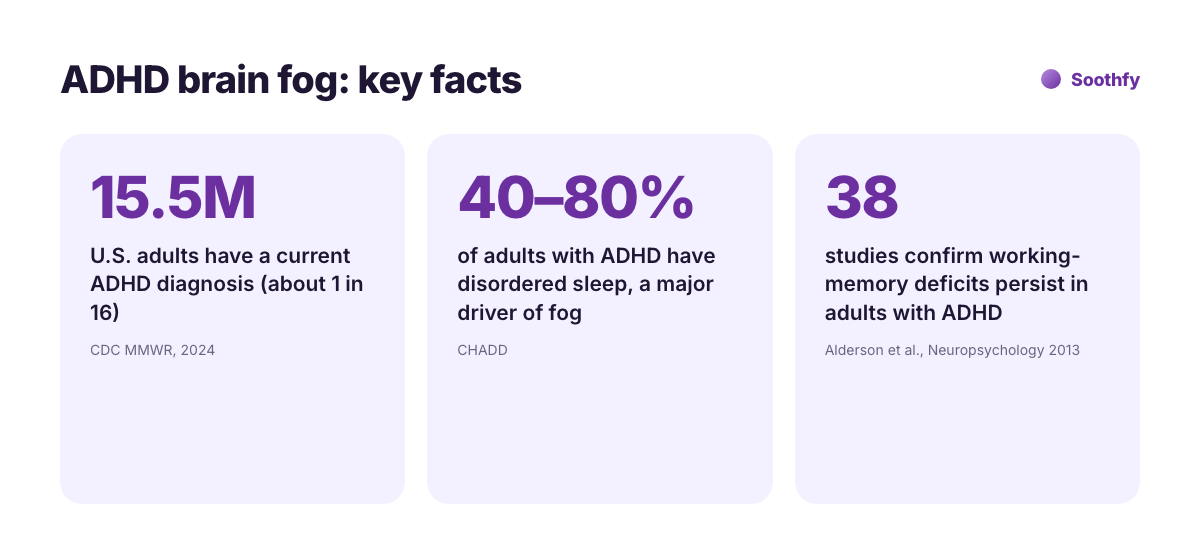
- About 15.5 million U.S. adults (6.0%) have a current ADHD diagnosis, and about half were diagnosed as adults (CDC, 2024).
- Disordered sleep affects an estimated 40–80% of adults with ADHD (CHADD).
- Working-memory deficits persist into adulthood in ADHD (meta-analysis of 38 studies, 2013).
- Dehydration beyond 2% of body mass impairs attention and executive function (meta-analysis of 33 studies, 2018).
- Cognitive disengagement syndrome, renamed from sluggish cognitive tempo in 2023, often co-occurs with ADHD and involves fogginess and slowed thinking.
Conclusion
ADHD brain fog isn't a character flaw, and it isn't permanent. It's what happens when a brain with a smaller "sticky note" gets overloaded, under-slept, dehydrated or pulled in ten directions at once. The fixes are simple, but they work best as daily habits, not emergency measures.
Start small: pick one fix from this guide (a consistent wake time, a 2-minute brain dump, or a 10-minute walk) and do it every day this week. Track how foggy you feel. By next week, you'll know more about your fog than most people ever do.
Start Your Free Soothfy PlanFrequently Asked Questions
1. Is brain fog a symptom of ADHD?
It isn't an official diagnostic criterion, but many adults with ADHD experience it. It comes from ADHD-related difficulties with working memory, attention and arousal, and gets worse with poor sleep, stress, dehydration and task-switching.
2. What does ADHD brain fog feel like?
Like thinking through cotton wool: losing the thread mid-sentence, rereading the same paragraph, struggling to find words, forgetting why you opened a tab, and feeling drained after small amounts of focus.
3. How long does ADHD brain fog last?
An episode can last minutes to most of a day. Fog from a skipped meal or dehydration often lifts within an hour of eating and drinking; fog from poor sleep can last all day. Because ADHD is lifelong, daily habits matter more than one-off fixes.
4. How do you get rid of ADHD brain fog fast?
Use the 5-minute reset: move for a minute, drink a full glass of water, brain-dump onto paper, circle the smallest next step, and start it with a timer and notifications off.
5. Can Adderall or other ADHD medication cause brain fog?
Some people feel foggy as a stimulant dose wears off, often in the afternoon, or if the dose or timing isn't right. Medication can also affect sleep and appetite. Others find it reduces fog. Track the pattern and talk to your prescriber.
6. What are natural remedies for ADHD brain fog?
Consistent sleep timing, regular exercise, hydration, regular meals, less task-switching and written memory aids. Omega-3 has modest evidence in children and teens with ADHD; ask your doctor before any supplement.
7. How do I deal with ADHD brain fog at work?
Brain-dump before starting, single-task with notifications off, take notes in meetings and ask for written follow-ups, walk before the afternoon dip, and keep water on your desk. You may also be able to request workplace accommodations.
8. What's the difference between ADHD brain fog and cognitive disengagement syndrome?
CDS (formerly sluggish cognitive tempo) involves daydreaming, fogginess, slowed thinking and daytime drowsiness. It often occurs with ADHD but is distinct. ADHD fog tends to feel scattered and restless; CDS feels spacey, slow and withdrawn.
9. What's the difference between ADHD brain fog and normal tiredness?
Normal tiredness has a clear cause and clears after good sleep. ADHD brain fog often lingers even after enough sleep, shows up most days and worsens with boring or multi-step tasks.
10. When should I see a doctor about brain fog?
If it's new, sudden or worsening; comes with memory loss, confusion, numbness or severe headaches; started after COVID-19 or another illness; or comes with low mood or hopelessness.
11. Can an app help with ADHD brain fog?
Yes. Apps can hold what your working memory drops, remind you of habits and show patterns. Soothfy builds daily anchor habits with mood tracking and a Brain Score; Goblin.tools breaks down tasks; Focusmate offers body doubling.
12. How does Soothfy help with ADHD brain fog?
Soothfy creates a personalized 30-day plan around morning, work and evening anchor habits, plus mood tracking, journaling, a daily Brain Score, CBT-based activities and quick relief tools. It's a support tool, not a diagnosis or treatment.
Sources
- Staley BS, et al. ADHD Diagnosis, Treatment, and Telehealth Use in Adults. CDC MMWR, 2024;73(40):890–895.
- Alderson RM, et al. ADHD and working memory in adults: a meta-analytic review. Neuropsychology, 2013;27(3):287–302.
- Characteristics of Sluggish Cognitive Tempo among adults with ADHD. Frontiers in Child and Adolescent Psychiatry, 2023.
- CHADD. Is Adult ADHD Related to Sleep Challenges?
- Wajszilber D, et al. Sleep disorders in patients with ADHD: impact and management challenges. Nature and Science of Sleep, 2018.
- Volkow ND, et al. Evaluating dopamine reward pathway in ADHD: clinical implications. JAMA, 2009.
- Wittbrodt MT, Millard-Stafford M. Dehydration Impairs Cognitive Performance: A Meta-analysis. Medicine & Science in Sports & Exercise, 2018.
- Zhao L, et al. Single exercise session and executive function in children and adolescents with ADHD: a three-level meta-analysis. BMC Pediatrics, 2025.
- Chang JP, et al. Omega-3 PUFAs in youths with ADHD: a systematic review and meta-analysis. Neuropsychopharmacology, 2018.
- Understood. ADHD medication rebound: what you need to know.
This article is for general information and is not medical advice. If you're struggling, talk to a qualified healthcare professional.
Download Soothfy Free on the App Store and Google Play