Best Daylio Alternatives in 2026: 10 Mood Trackers for Depression & Low Mood Compared (Real Ratings & Prices)
By Soothfy Team ·
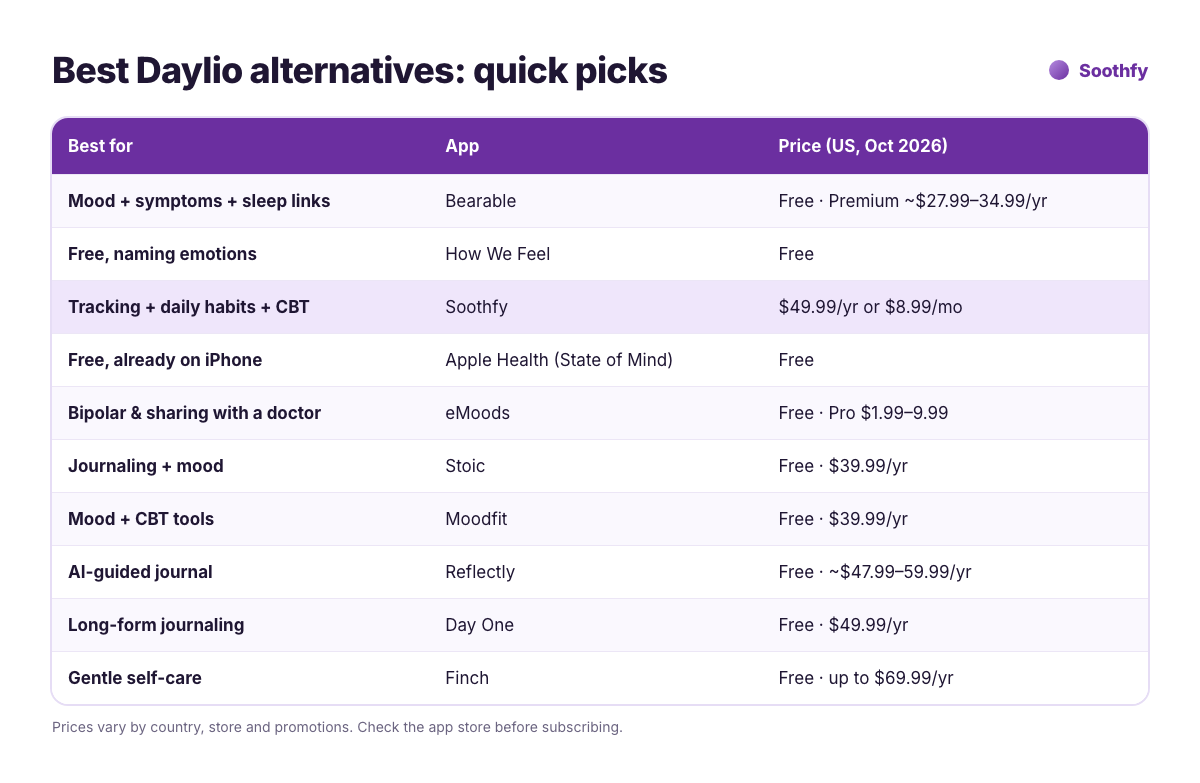
The best Daylio alternatives in 2026: Bearable, How We Feel, Apple Health, eMoods, Stoic, Moodfit, Soothfy and more, compared for mood and depression.
Quick answer: the best Daylio alternatives in 2026
- Bearable: best for finding out why your mood changes (links mood to sleep, symptoms and medication)
- How We Feel: best free alternative (nonprofit, no paywall)
- Soothfy: best for doing something about low mood: tracking plus daily habits and CBT ($49.99/yr)
- Apple Health (State of Mind): free and already on your iPhone, with the PHQ-9 depression questionnaire
- eMoods: best for bipolar disorder and sharing reports with a doctor
- Stoic, Day One, Reflectly: best if you'd rather write than tap icons
- Moodfit: mood tracking with CBT tools
You've tapped the little faces in Daylio every night for months. Rad, good, meh, bad, awful. There's a streak, a colourful Year in Pixels, maybe a few hundred entries. And then something nudged you to look elsewhere: a paywall in front of your own stats, a free-trial pop-up, an entry that vanished, or the feeling that logging "meh" every day isn't actually making you feel better.
That last one matters most if you're tracking because of depression or low mood. A mood tracker is only as useful as what you do with it.
We compared 10 Daylio alternatives using live U.S. App Store ratings and prices (checked October 2026), analysed Daylio's 500 most recent U.S. App Store reviews, and looked at what research says about mood tracking and depression.
This guide is for you if:
- You use Daylio (or tried it) and hit the paywall, lost data, or want more insight
- You track your mood because of depression, anxiety, bipolar disorder or stress
- You want a free mood tracker, or one already on your phone
- You want your tracking to lead to feeling better, not just a prettier chart
1. What Is Daylio?
Daylio is a "micro-diary" mood tracker. Instead of writing, you tap a mood and the activities you did that day, and Daylio turns those entries into charts, streaks and a Year in Pixels so you can spot patterns over time.
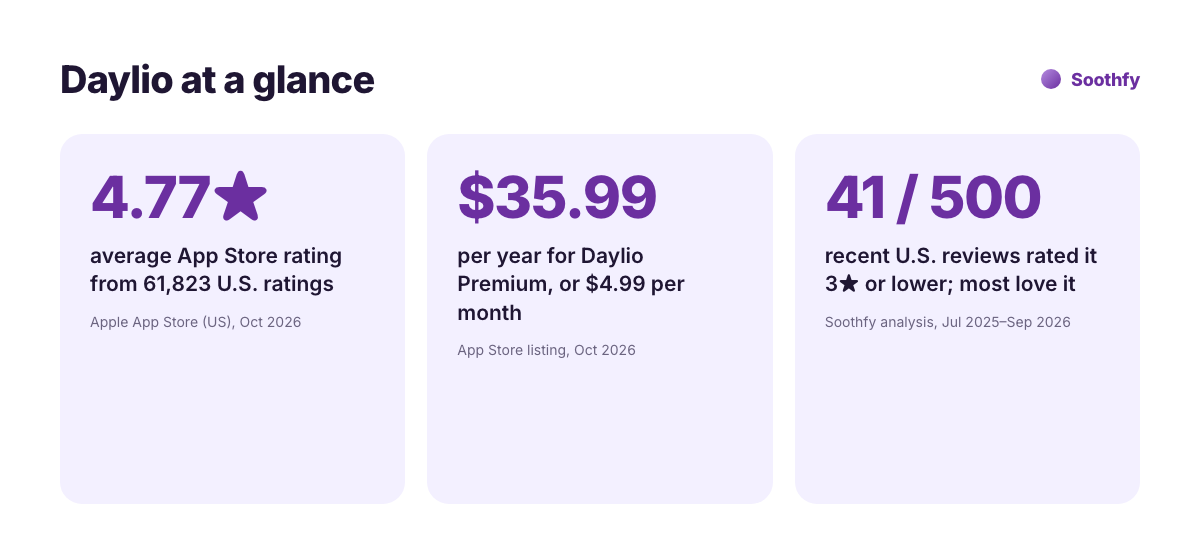
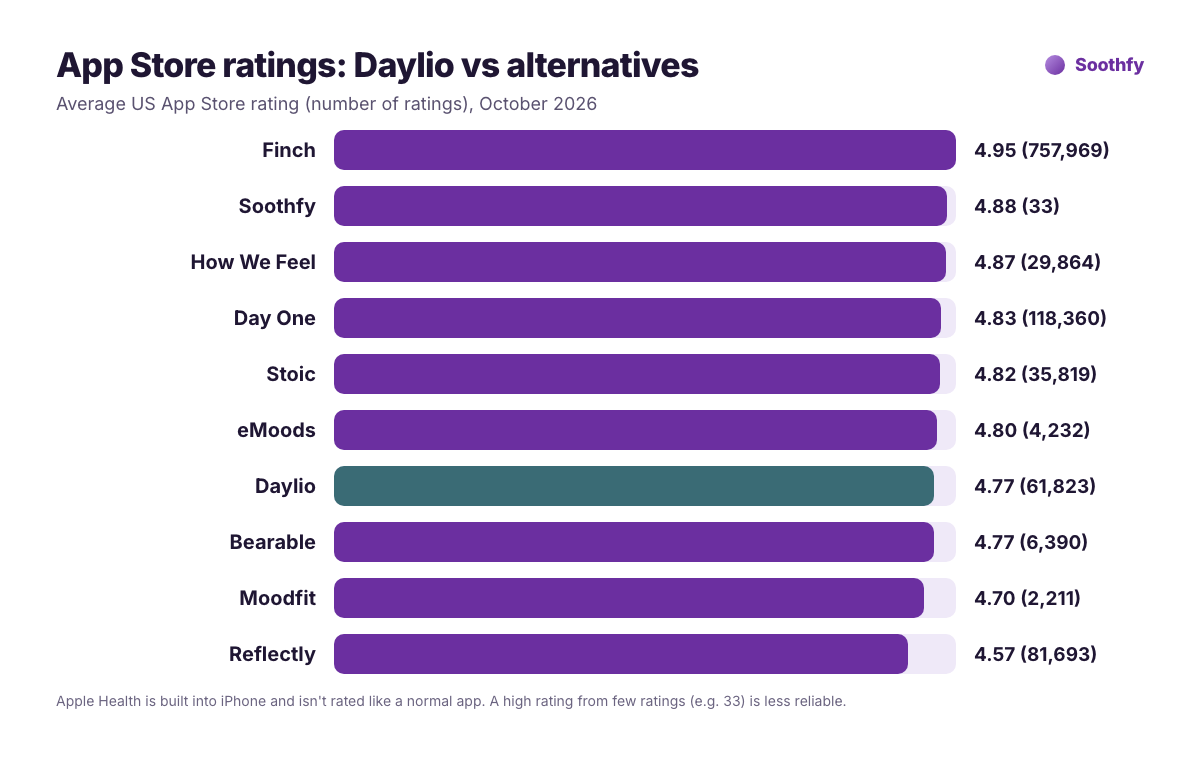
Daylio is one of the most popular mood trackers in the world, with a 4.77★ average from 61,823 U.S. App Store ratings (October 2026). Its biggest strength is speed: logging takes seconds, with no writing required.
Daylio pricing (U.S. App Store, October 2026)
- Free: basic mood and activity logging
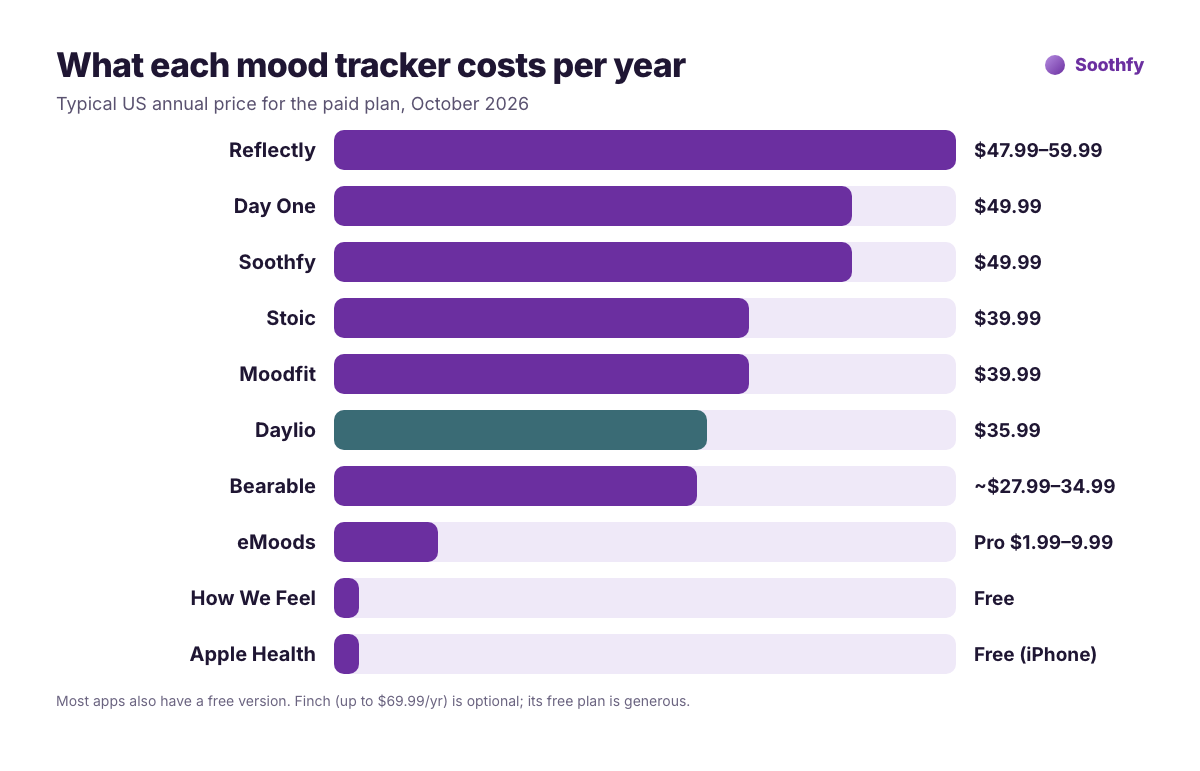
- Daylio Premium: $35.99/year or $4.99/month (other plan prices, up to $59.99, are also listed)
Why people look for Daylio alternatives
Most people love Daylio: of its 500 most recent U.S. App Store reviews (July 2025–September 2026), 459 were 4–5★. Happy reviewers most often praise how quick and simple it is, the patterns and statistics, and the habit streaks. But the 41 critical reviews point to clear reasons people switch:
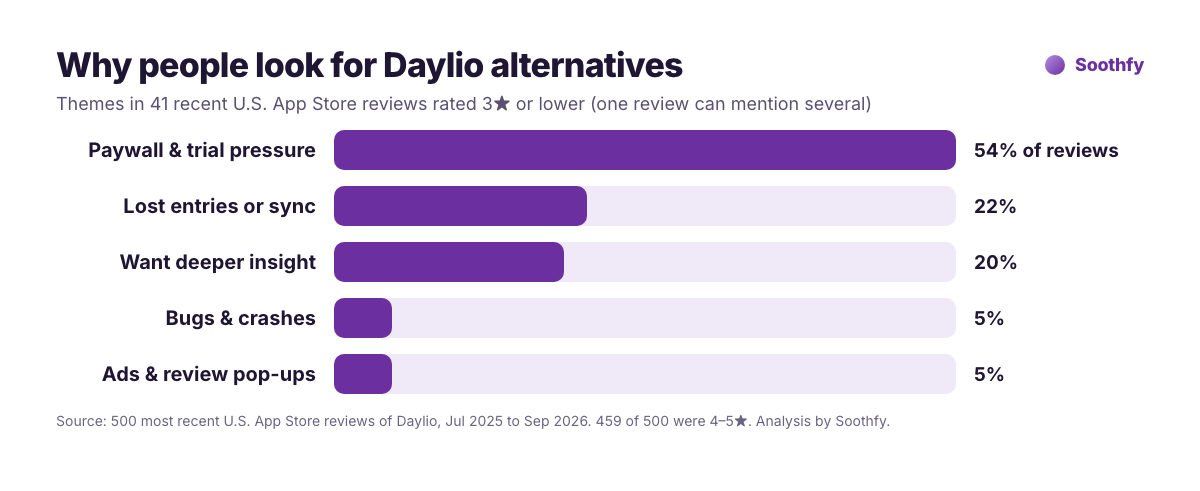
- Paywall and free-trial pressure (54%): reviewers mention trial prompts on first open, and some say their own statistics were locked behind Premium.
- Lost entries or sync problems (22%): some reviewers report entries or voice recordings disappearing, or data not syncing between devices.
- Wanting deeper insight (20%): some feel icon-based logging is too limited and want to understand why their mood changes.
Method: we grouped the 41 critical reviews by theme; one review can mention several. Read Daylio's App Store reviews.
2. Does Mood Tracking Actually Help With Depression?
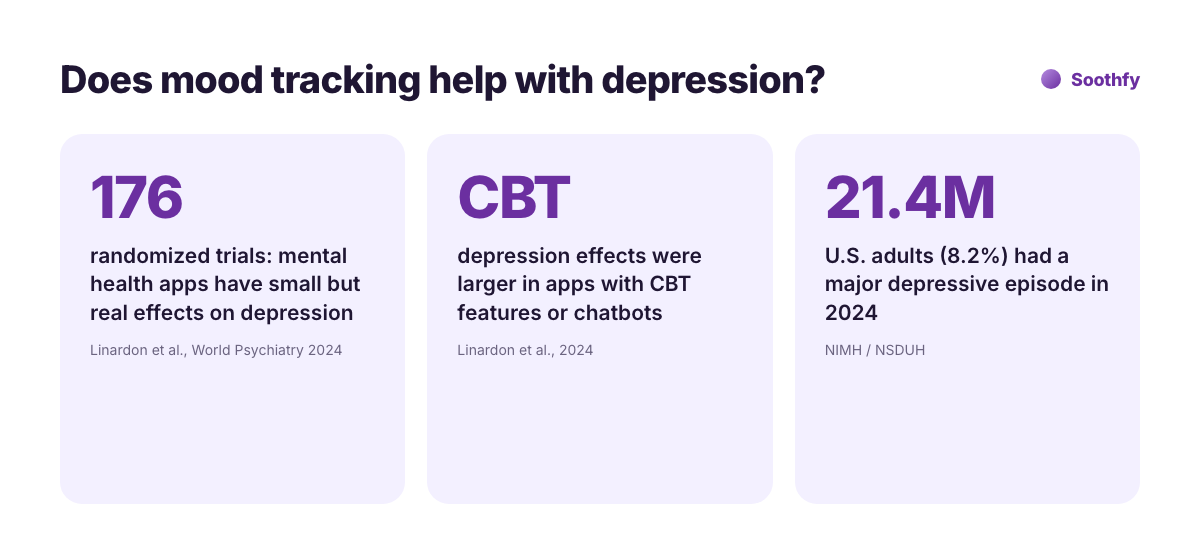
The honest answer: it can, but tracking alone isn't treatment.
In other words, noticing your mood helps, and pairing that awareness with something you do (like CBT techniques or small daily habits) tends to help more. That's worth keeping in mind as you choose.
Depression is common: 8.2% of U.S. adults, about 21.4 million people, had a major depressive episode in 2024 (NIMH). If you're tracking because your mood has been low for a while, also read How to Break Out of a Depression Spiral.
3. What Do You Want From a Mood Tracker?
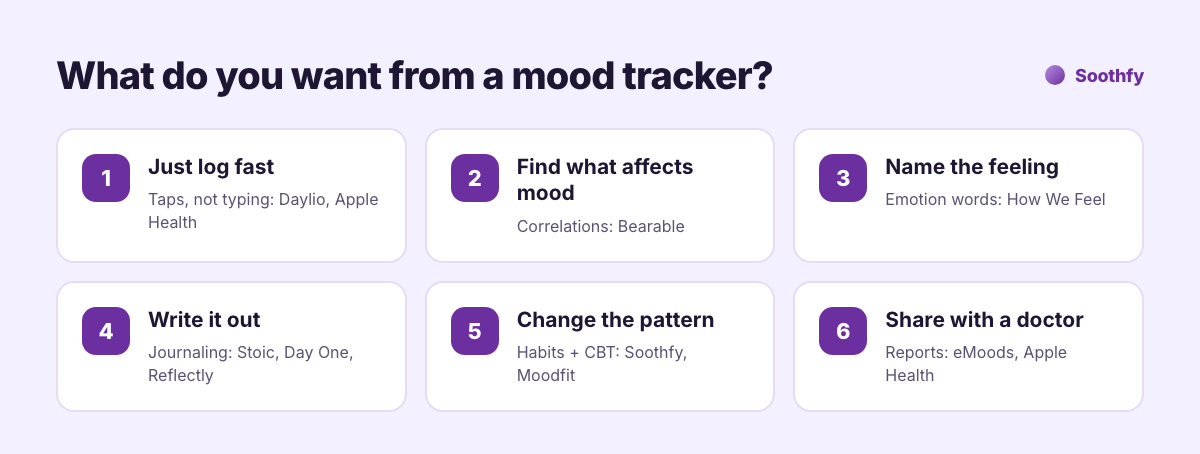
- Log fast: taps, not typing (Daylio, Apple Health)
- Find what affects your mood: correlations with sleep, symptoms and habits (Bearable)
- Name the feeling: precise emotion words (How We Feel)
- Write it out: journaling with prompts (Stoic, Day One, Reflectly)
- Change the pattern: habits and CBT tools (Soothfy, Moodfit)
- Share with a doctor: reports and questionnaires (eMoods, Apple Health)
4. How We Chose
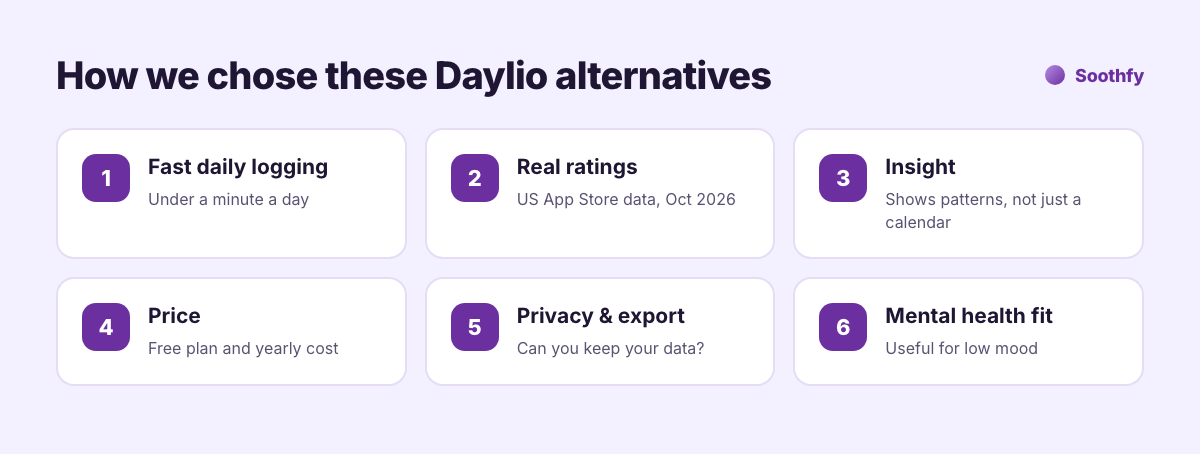
- Fast daily logging: under a minute a day, because consistency matters more than detail
- Real ratings: U.S. App Store averages and rating counts, October 2026
- Insight: shows patterns, not just a calendar of faces
- Price: free plan and U.S. yearly price
- Mental health fit: useful if you're tracking depression, anxiety or bipolar disorder
No app paid to be included. Soothfy is our own app; we've placed it in one specific category and been clear about where others are the better choice.
5. Daylio Alternatives Compared
| App | Best for | App Store rating | Price (US) |
|---|---|---|---|
| Daylio (reference) | Fast icon-based logging | 4.77 (61,823) | Free · $35.99/yr |
| Bearable | Mood + symptom correlations | 4.77 (6,390) | Free · ~$27.99–34.99/yr |
| How We Feel | Free emotion check-ins | 4.87 (29,864) | Free |
| Soothfy | Tracking + habits + CBT | 4.88 (33) | $49.99/yr · $8.99/mo |
| Apple Health | Free, built into iPhone | Built in | Free |
| eMoods | Bipolar, doctor reports | 4.80 (4,232) | Free · Pro $1.99–9.99 |
| Stoic | Journaling + mood | 4.82 (35,819) | Free · $39.99/yr |
| Moodfit | Mood + CBT tools | 4.70 (2,211) | Free · $39.99/yr |
| Reflectly | AI-guided journal | 4.57 (81,693) | Free · ~$47.99–59.99/yr |
| Day One | Long-form journaling | 4.83 (118,360) | Free · $49.99/yr |
| Finch | Gentle self-care | 4.95 (757,969) | Free · up to $69.99/yr |
Ratings: U.S. App Store, October 2026. Prices: App Store listings, checked October 2026; they vary by country, store and promotions.
6. The 10 Best Daylio Alternatives in 2026
1. Bearable: Best for Finding Out Why Your Mood Changes
Free · Premium ~$27.99–34.99/yr · iPhone, Android
If Daylio tells you when you felt bad, Bearable tries to tell you why. You track mood alongside sleep, energy, symptoms, medication and habits, and it shows which factors line up with better or worse days. 4.77★ from 6,390 ratings.
Pros: the deepest insights of any app here; great for chronic illness, ADHD or medication changes.
Cons: more setup than Daylio; can feel like a lot to log on bad days.
Best for: people who want to understand their triggers and patterns.
2. How We Feel: Best Free Daylio Alternative
Free · iPhone, Android
How We Feel is completely free, made by a nonprofit working with the Yale Center for Emotional Intelligence. Instead of five faces, you choose from dozens of specific emotions, and it suggests short strategies for working with each one (howwefeel.org). 4.87★ from 29,864 ratings.
Pros: no paywall at all; builds emotional vocabulary; science-backed.
Cons: less focus on activities and habits than Daylio.
Best for: anyone who left Daylio over the paywall, or who feels "bad" but can't name it.
3. Soothfy: Best for Doing Something About Low Mood
Free trial · $49.99/yr or $8.99/mo · iPhone, Android
Daylio shows you a pattern. Soothfy is built for the next step: changing it. You track your mood and journal like you would in Daylio, but Soothfy also builds a personalized 30-day plan around three small daily anchor habits (morning, work and evening), with short CBT-based activities each day.
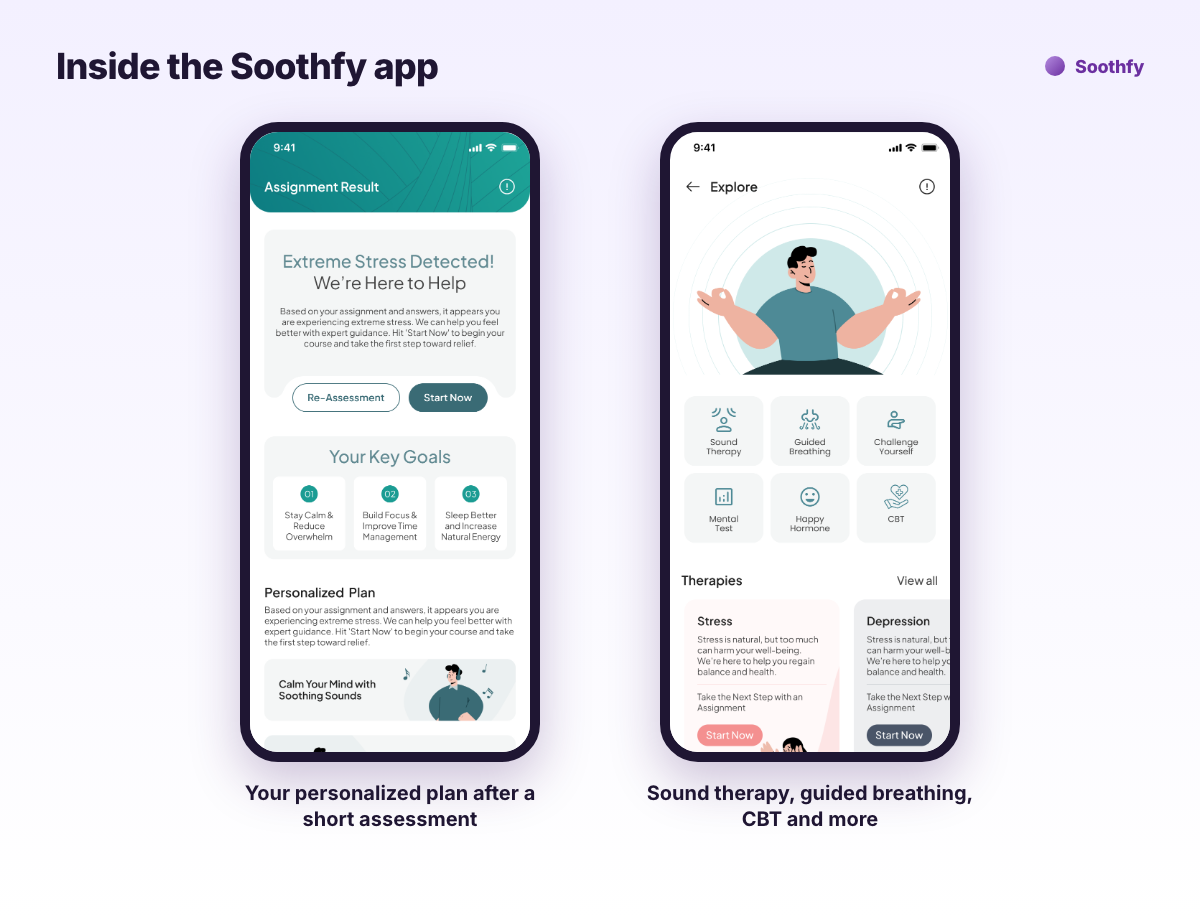
Key features: mood tracking and journaling · a daily Brain Score (0–100) that reflects your anchors, mood, journaling and relief tools · three daily anchor habits with streaks and a grace period · CBT-based activities · quick relief tools, guided breathing and sound therapy.
Pros: turns tracking into small daily actions, the combination research links to bigger benefits; one missed day doesn't reset your streak.
Cons: not a detailed symptom tracker like Bearable; newer app with fewer ratings (4.88★ from 33).
Best for: people tracking because of low mood or depression who want something to do each day.
4. Apple Health (State of Mind): Best Free Option Already on Your iPhone
Free · iPhone and iPad (iOS 17+), Apple Watch (watchOS 10+)
Many people don't realise their iPhone already has a mood tracker. Since iOS 17, the Health app includes State of Mind: you log a momentary emotion or your mood for the day on a scale from very unpleasant to very pleasant, pick words that describe it and what's affecting it, and see charts over weeks or months (MacRumors). The Health app also includes the PHQ-9 (depression) and GAD-7 (anxiety) questionnaires that clinicians use for screening (Apple Support).
Pros: free, private to your Health data, no extra app; you can log from an Apple Watch.
Cons: iPhone only; basic compared with dedicated apps; questionnaire results are informational, not a diagnosis.
Best for: iPhone users who want simple, free mood logging.
5. eMoods: Best for Bipolar Disorder and Sharing With a Doctor
Free · Pro listed at $1.99–9.99 · iPhone, Android
eMoods was designed for people with bipolar disorder. You track highs and lows (not just "good" or "bad"), plus sleep, medication and symptoms, and it creates reports you can share with your psychiatrist or therapist. 4.80★ from 4,232 ratings.
Pros: built for mood disorders; clinician-friendly reports; low cost.
Cons: plain design; less useful if you just want general wellbeing tracking; the iPhone app was last updated in December 2025.
Best for: anyone managing bipolar disorder or medication with a clinician.
6. Stoic: Best for Journaling Plus Mood
Free · $39.99/yr or $6.99/mo · AI tier $99.99/yr · iPhone, Android
Stoic combines a quick mood check-in with guided morning and evening journaling prompts. If Daylio felt too shallow, Stoic adds reflection without a blank page. 4.82★ from 35,819 ratings.
Pros: structured prompts; calm design; good balance of speed and depth.
Cons: requires writing; the AI tier is expensive.
Best for: people who want daily reflection, not just a mood score.
7. Moodfit: Best for Mood Tracking Plus CBT Tools
Free · $39.99/yr or $9.99/mo · iPhone, Android
Moodfit pairs mood tracking with CBT-style tools such as thought records, breathing exercises and goals, and shows how your activities relate to mood. 4.70★ from 2,211 ratings.
Pros: tracking and CBT in one place; customisable.
Cons: less polished than bigger apps; fewer ratings.
Best for: people who want to challenge negative thoughts, not just record them.
8. Reflectly: Best AI-Guided Journal
Free · ~$47.99–59.99/yr or $9.99/mo · iPhone, Android
Reflectly asks how you're feeling and then guides you with follow-up prompts, so journaling feels more like a conversation. 4.57★ from 81,693 ratings.
Pros: friendly, guided format; good for building a journaling habit.
Cons: one of the pricier options; lower rating than most here.
Best for: people who want prompts to help them open up.
9. Day One: Best for Long-Form Journaling
Free · Silver $49.99/yr or $8.99/mo · iPhone, Android, Mac
Day One is a full journaling app rather than a mood tracker, with photos, audio, locations and templates. If you've outgrown Daylio's icons and want a lasting diary, it's one of the most trusted options. 4.83★ from 118,360 ratings.
Pros: excellent writing experience; rich entries; strong reputation.
Cons: no built-in mood charts like Daylio; more effort per entry.
Best for: people who process feelings by writing.
10. Finch: Best for Gentle Check-Ins on Hard Days
Free · Finch Plus up to $69.99/yr · iPhone, Android
Finch turns mood check-ins and small self-care goals into caring for a virtual pet bird. On low-energy days it can feel kinder than staring at a chart. 4.95★ from 757,969 ratings.
Pros: gentle and motivating; generous free plan.
Cons: lighter insights than Daylio or Bearable.
Best for: people who need encouragement more than data. See Finch app alternatives.
7. Which Daylio Alternative Is Right for You?
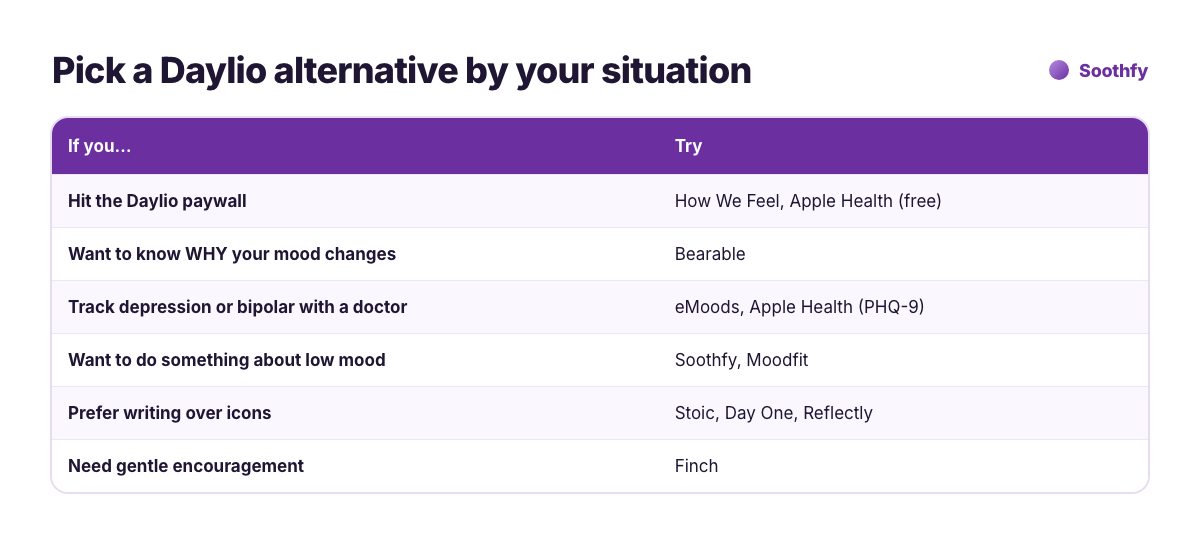
| If you… | Try |
|---|---|
| Hit the Daylio paywall | How We Feel, Apple Health (free) |
| Want to know why your mood changes | Bearable |
| Track depression or bipolar with a doctor | eMoods, Apple Health (PHQ-9) |
| Want to actually improve low mood | Soothfy, Moodfit |
| Prefer writing to tapping icons | Stoic, Day One, Reflectly |
| Lost data and want reliability | Apple Health, Day One |
8. Free Daylio Alternatives
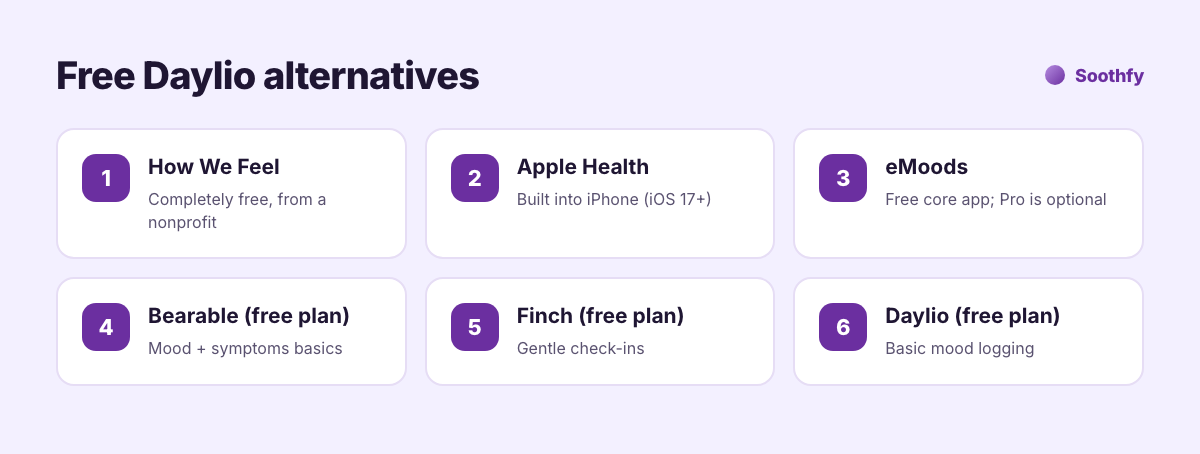
- How We Feel: completely free, from a nonprofit
- Apple Health: free and built into iPhone (iOS 17+)
- eMoods: free core app; Pro is optional
- Bearable, Finch and Daylio all have free plans with limits
9. How to Make Mood Tracking Actually Help
Whichever app you choose, the way you use it matters more than the app itself:
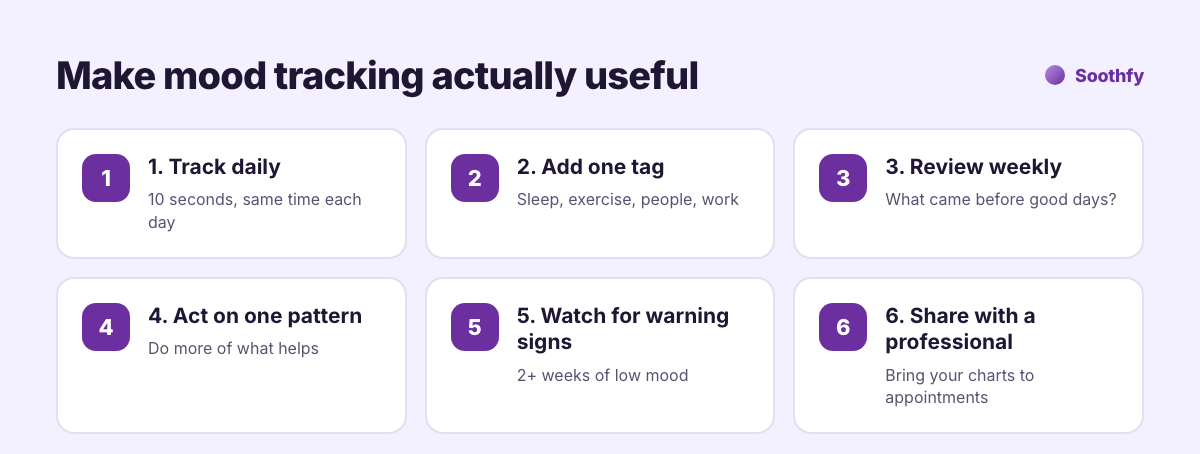
- Track daily, at the same time: 10 seconds is enough.
- Add one tag: sleep, exercise, people or work. More tags means more abandoned apps.
- Review weekly: what came before your good days?
- Act on one pattern: if walks line up with better days, schedule three walks this week. This is the idea behind behavioral activation, a well-established CBT approach for depression.
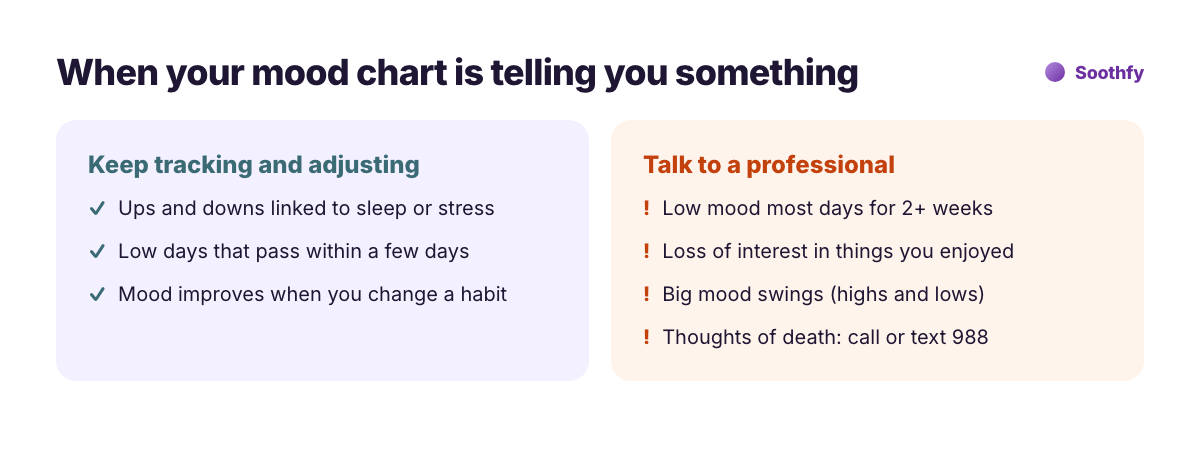
- Watch for warning signs: low mood most days for two weeks or more is a reason to talk to someone.
- Share with a professional: your charts make appointments far more useful.
If your mood dips are tied to sleep or stress, see 7 Strategies to Fix Sleep Problems and Why Your Body Stays in Fight-or-Flight Mode. If big emotions swing your mood, read Why You Feel Everything So Intensely.
10. How to Switch From Daylio Without Losing Your Data
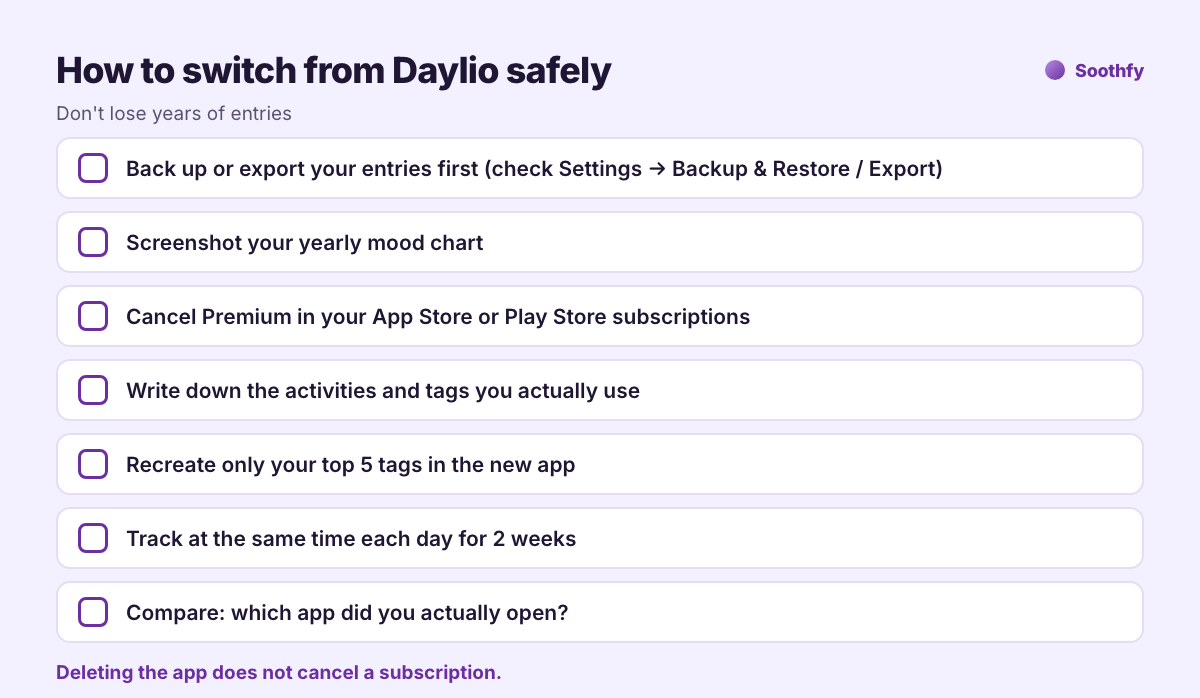
- Back up or export first. Check Daylio's settings for backup and export options before you do anything else.
- Screenshot your yearly charts. They're a useful record even if no app can import them.
- Cancel Premium in your App Store or Google Play subscriptions. Deleting the app doesn't cancel it.
- Recreate only your top 5 tags in the new app.
- Track at the same time each day for two weeks, then decide whether to keep it.
Key Facts: Daylio Alternatives in 2026
- Daylio has a 4.77★ average from 61,823 U.S. App Store ratings; Premium is $35.99/year or $4.99/month in the U.S.
- Of Daylio's 500 most recent U.S. App Store reviews (Jul 2025–Sep 2026), 459 were 4–5★; the most common complaints were paywalls and trial prompts, lost entries or sync, and wanting deeper insight.
- Apple Health has included free mood logging (State of Mind) and the PHQ-9 and GAD-7 questionnaires since iOS 17.
- How We Feel is a completely free mood tracker from a nonprofit.
- A 2024 meta-analysis of 176 trials found apps have small but significant effects on depression, with larger effects for apps with CBT features or chatbots.
Final Verdict
If you left Daylio because of the paywall, start with How We Feel or Apple Health: both are free. If you want to understand your triggers, choose Bearable. If you're managing bipolar disorder, use eMoods. If you'd rather write, try Stoic or Day One. And if you're tracking because of low mood and want the tracking to lead somewhere, Soothfy pairs your mood log with small daily habits and CBT activities.
For more support, see Best Wysa Alternatives for AI and anxiety apps, our habit app comparison, and ADHD and Depression Statistics.
Start Your Free Soothfy PlanFrequently Asked Questions
1. What is the best alternative to Daylio?
Bearable for understanding what affects your mood, How We Feel for a free option, Apple Health if you're on iPhone, eMoods for bipolar disorder, Stoic, Day One or Reflectly if you prefer writing, and Soothfy or Moodfit to pair tracking with tools that improve low mood.
2. Is there a free alternative to Daylio?
Yes. How We Feel is completely free, and Apple Health includes free mood logging on iPhone (iOS 17+). eMoods, Bearable, Finch and Daylio also have free versions.
3. How much does Daylio Premium cost?
In the U.S. App Store, Daylio Premium is $35.99/year or $4.99/month as of October 2026, with other plan prices also listed. Prices vary by country.
4. Can I track my mood for free on iPhone?
Yes. The Health app's State of Mind feature (iOS 17+) lets you log emotions and daily moods and see charts over time. It also includes the PHQ-9 and GAD-7 questionnaires, which are informational, not a diagnosis.
5. Does mood tracking help with depression?
It can. A randomized trial found mobile self-monitoring increased emotional self-awareness, which reduced depressive symptoms in young people. A 2024 meta-analysis of 176 trials found small but significant effects of apps on depression, larger in apps with CBT features or chatbots. Tracking works best when you act on it and share it with a professional.
6. What is the best mood tracker for depression?
One that helps you act, not just log: Soothfy or Moodfit for habits and CBT tools, Bearable for spotting what helps, and Apple Health for the PHQ-9 questionnaire. If low mood lasts more than two weeks, talk to a doctor.
7. What is the best mood tracker for bipolar disorder?
eMoods. It tracks highs and lows, sleep, medication and symptoms, and creates reports to share with your clinician (4.80★ from 4,232 ratings).
8. Why do people stop using Daylio?
Most reviewers love it (459 of its 500 most recent U.S. reviews were 4–5★). Among critical reviews, the main complaints were paywalls and trial prompts, lost entries or sync problems, and wanting deeper insight.
9. How do I move my data from Daylio?
Back up or export your entries from Daylio's settings and screenshot your charts first. Cancel Premium through your App Store or Google Play subscriptions. Most apps can't import Daylio data directly, so keep the export as an archive.
10. Is Daylio good for anxiety?
It can help you notice anxiety patterns. For tools to manage anxiety itself, pair a tracker with a CBT or relief app; see our guide to Wysa alternatives.
11. How does Soothfy compare to Daylio?
Daylio is a quick micro-diary. Soothfy includes mood tracking and journaling plus a personalized 30-day plan of daily anchor habits, CBT-based activities, a daily Brain Score and quick relief tools, for $49.99/year or $8.99/month.
12. When should I talk to a doctor about my mood?
If low mood lasts most days for two weeks or more, you lose interest in things you enjoyed, you notice big mood swings, or mood affects work, sleep or relationships. If you have thoughts of suicide, call or text 988 in the U.S. right away.
Sources
- Apple App Store (US) listings, ratings and in-app prices checked October 2026: Daylio, Bearable, How We Feel, eMoods, Stoic, Moodfit, Reflectly, Day One, Finch, Soothfy.
- Kauer SD, et al. Self-monitoring Using Mobile Phones in the Early Stages of Adolescent Depression: Randomized Controlled Trial. Journal of Medical Internet Research, 2012.
- Linardon J, et al. Current evidence on the efficacy of mental health smartphone apps for symptoms of depression and anxiety: a meta-analysis of 176 randomized controlled trials. World Psychiatry, 2024.
- National Institute of Mental Health. Major Depression statistics.
- Apple Support. Understand and use Mental Health Assessments in the Health app.
- MacRumors. iOS 17: How to Track Your Mood With Apple Health.
- Review analysis: 500 most recent U.S. App Store reviews of Daylio (July 2025–September 2026), grouped by theme by Soothfy.
This article is for general information and is not medical advice. Apps, prices and features change; last checked October 1, 2026.
Download Soothfy Free on the App Store and Google Play