Best Tiimo Alternatives in 2026: 10 ADHD Planners Compared (Real Ratings & Prices)
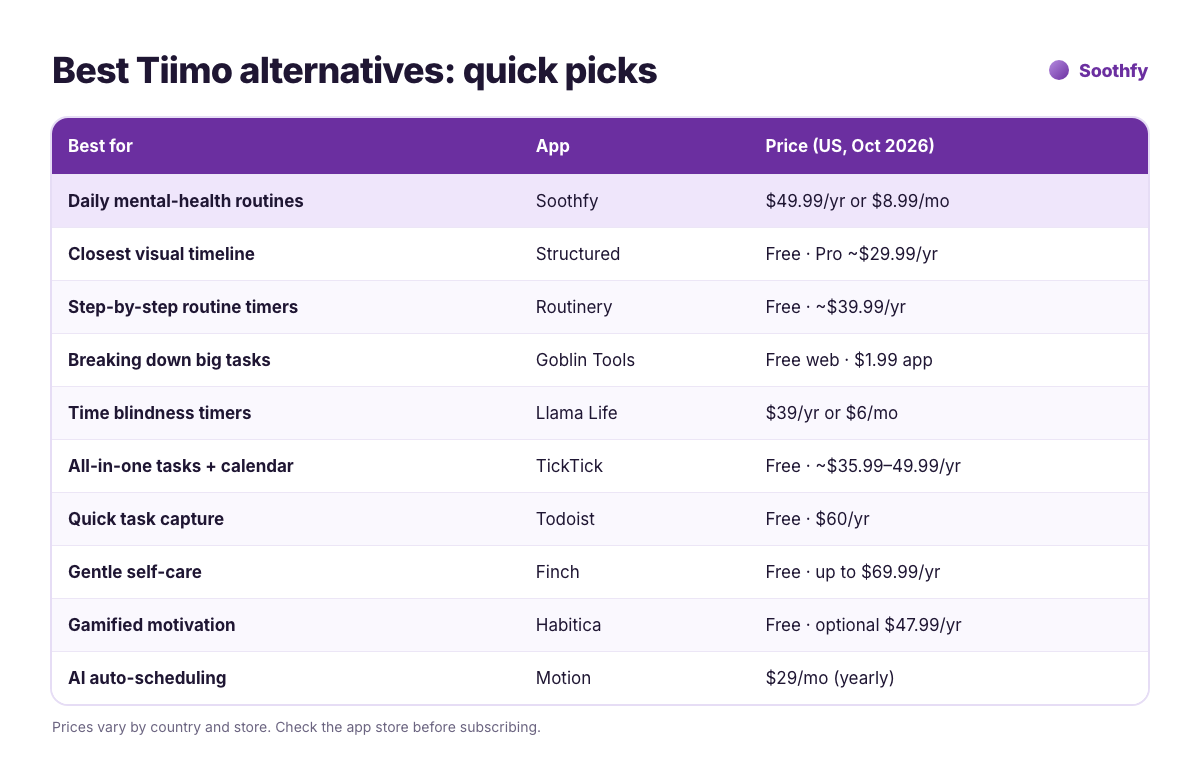
Structured is the closest match (a visual timeline of your day, strong free plan, about $30/yr for Pro). Routinery is best for step-by-step routines, Goblin Tools is the best free option for breaking down big tasks, Llama Life is best for time blindness, TickTick and Todoist are best if you need a full task manager, and Soothfy is best if you want ADHD routines combined with support for stress, anxiety and low mood. Tiimo itself is still excellent (Apple's iPhone App of the Year 2025), but recent reviewers most often leave over missing features, AI-focused changes, calendar sync bugs and price.
You downloaded Tiimo because it promised something most planners don't: a calm, visual day built for a brain that loses track of time. And for a while, it probably helped. Then something didn't fit. Maybe your Outlook calendar wouldn't sync, maybe you couldn't set a task to repeat twice a week, or maybe the subscription renewed and you thought, "Is there something that does this for less?"
You're not alone. We read the 100 most recent U.S. App Store reviews of Tiimo (December 2025 to August 2026) and pulled live App Store ratings and prices for 10 alternatives. This guide shows you which app fits your ADHD struggle, not just which one has the longest feature list.
This guide is for you if:
- You use Tiimo (or tried it) and want something cheaper, simpler or more flexible
- You have ADHD or another neurodivergent brain and need a planner that reduces mental load
- You want a free option, or one that works on Android or your computer
- You want honest pros and cons, with real ratings and prices
What Is Tiimo, and Why Look for an Alternative?
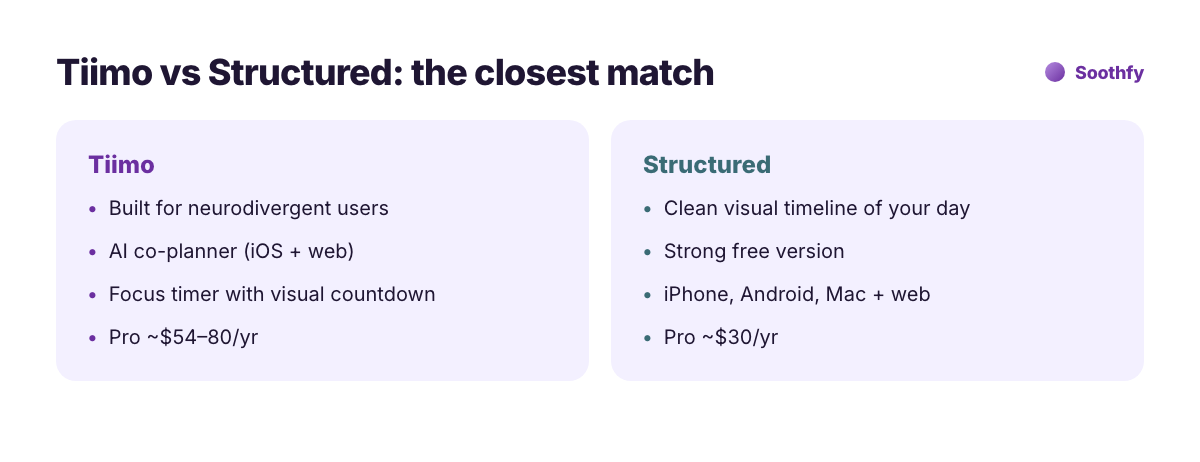
Tiimo is a visual daily planner designed for neurodivergent people, especially those with ADHD and autism. It shows your day as a color-coded visual schedule with a focus countdown timer, a to-do list and, since 2025, an AI co-planner that helps break down and schedule tasks.
Tiimo is genuinely good. Apple named it iPhone App of the Year 2025, it was an Apple Design Awards finalist in 2024, and it holds a 4.59★ average from 20,377 U.S. App Store ratings (October 2026). If it's working for you, you don't need to switch.
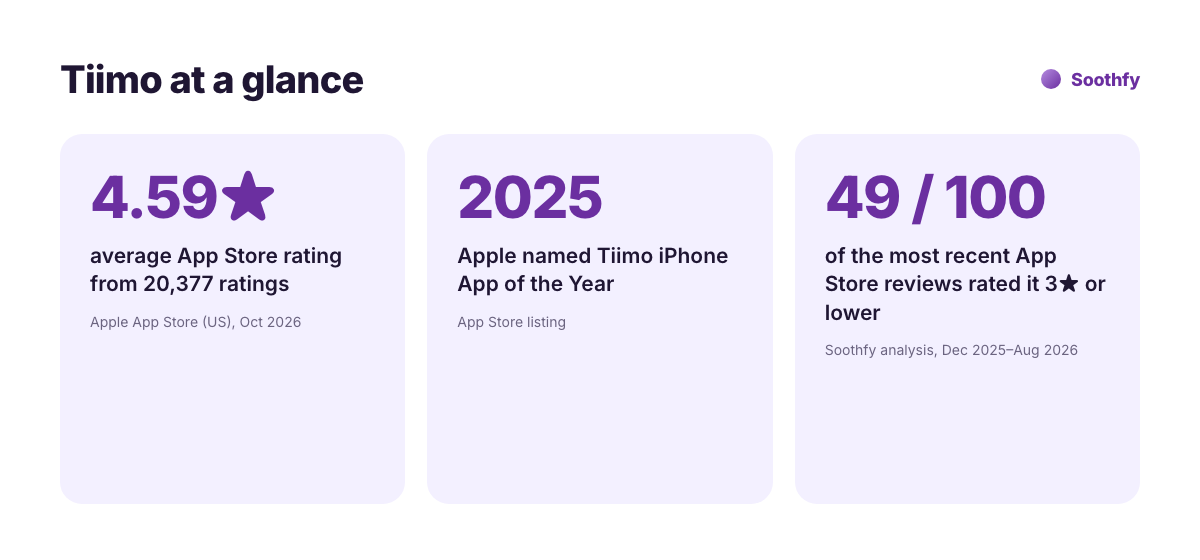
But its recent reviews tell a more mixed story. Of the 100 most recent U.S. App Store reviews, 51 were 4–5★ and 49 were 3★ or lower. Here's what the critical reviews talked about most:
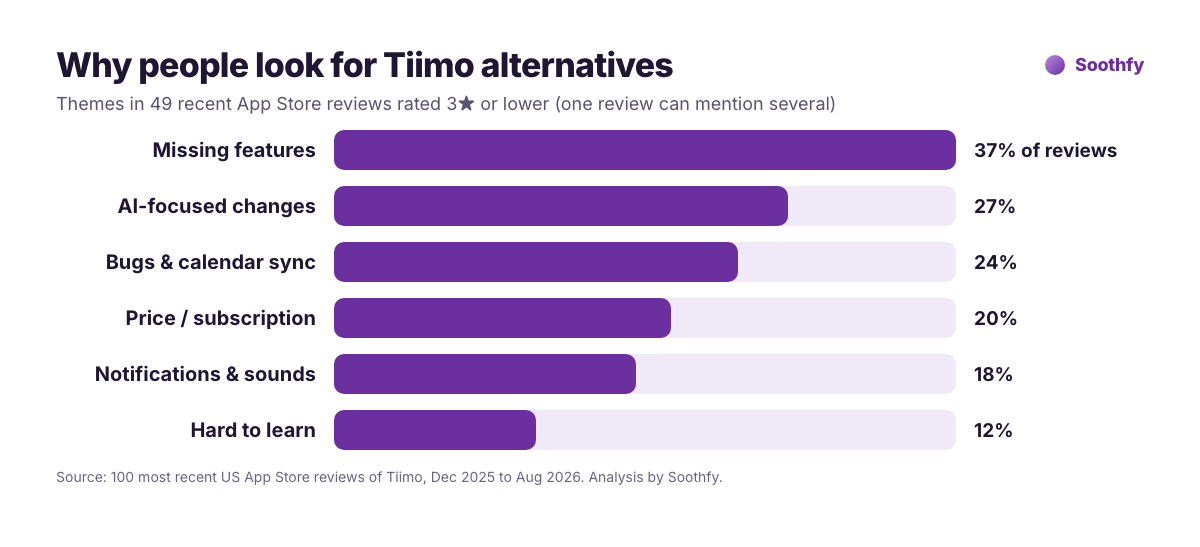
- Missing features (37%): reviewers mention not being able to repeat a task a set number of times per week, needing reminders several times a day, or wanting to remove preset tasks.
- AI-focused changes (27%): some reviewers feel recent updates focus on the AI assistant rather than core planning, and a few are uncomfortable sharing personal details with it.
- Bugs and calendar sync (24%): several reviewers report unreliable Google Calendar sync and no Outlook support.
- Price and subscription (20%): complaints about cost, trials and cancelling.
- Notifications and sounds (18%): reminders or focus music not playing reliably, which matters a lot for time blindness.
None of this makes Tiimo a bad app. It means that depending on what you need, another app may fit better. Method: we grouped the 49 critical reviews by theme; one review can mention several themes. Read Tiimo's App Store reviews.
How We Chose the Best Tiimo Alternatives
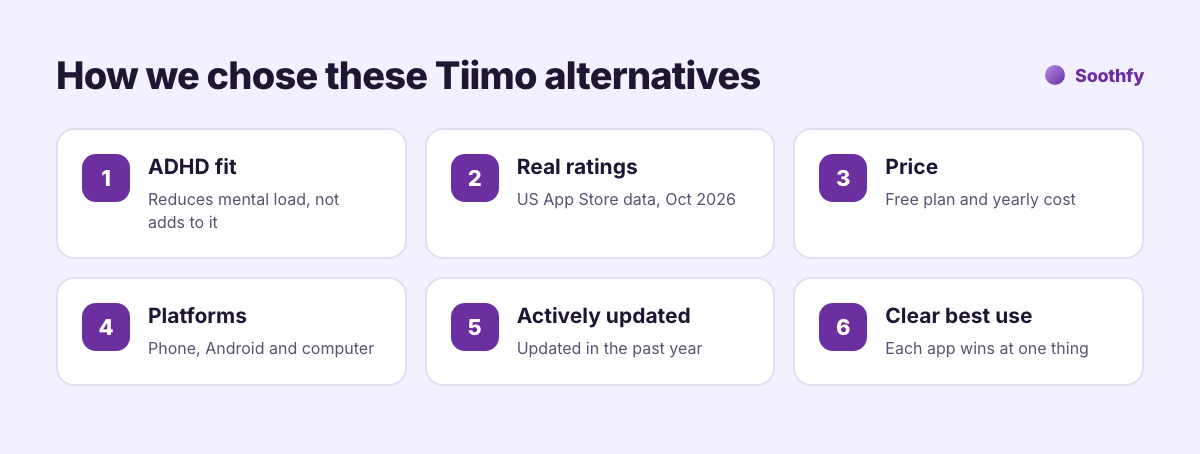
- ADHD fit: does it reduce mental load, or add setup and decisions?
- Real ratings: average U.S. App Store rating and number of ratings, checked in October 2026.
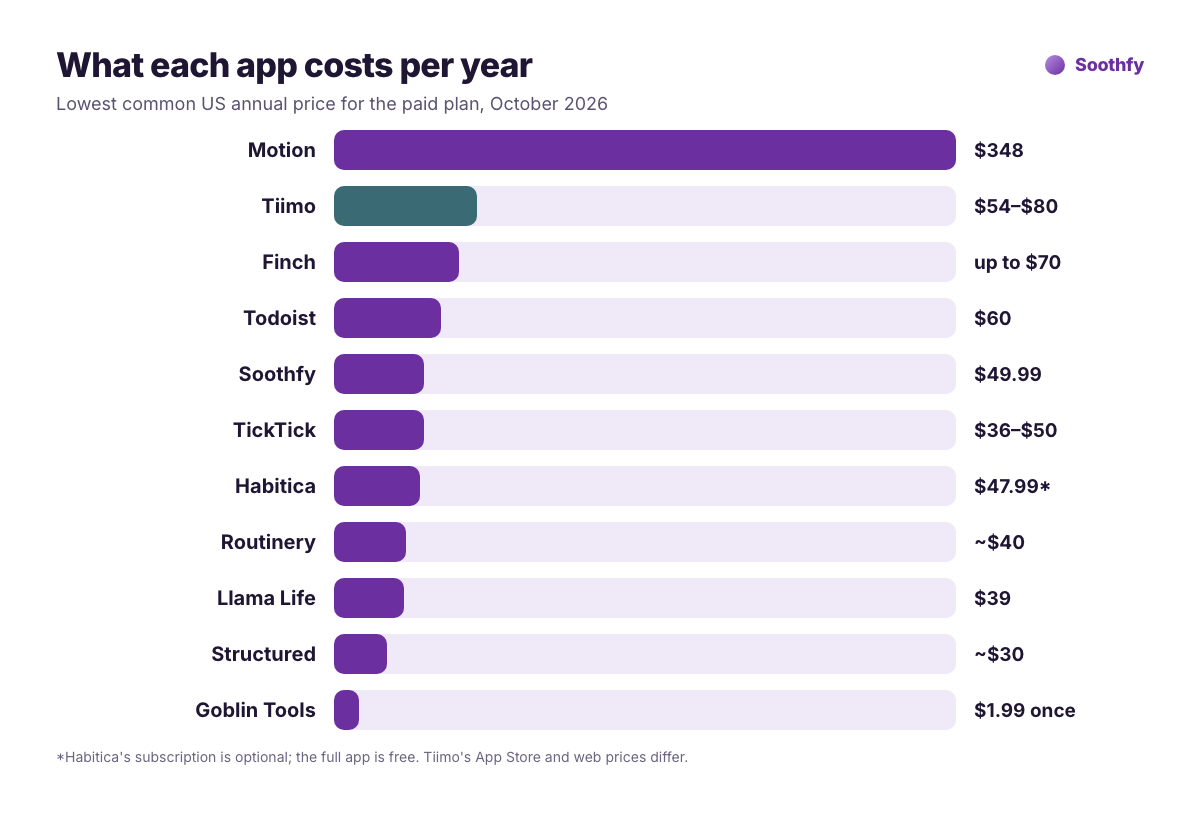
- Price: what's free, and what the paid plan costs per year in the U.S.
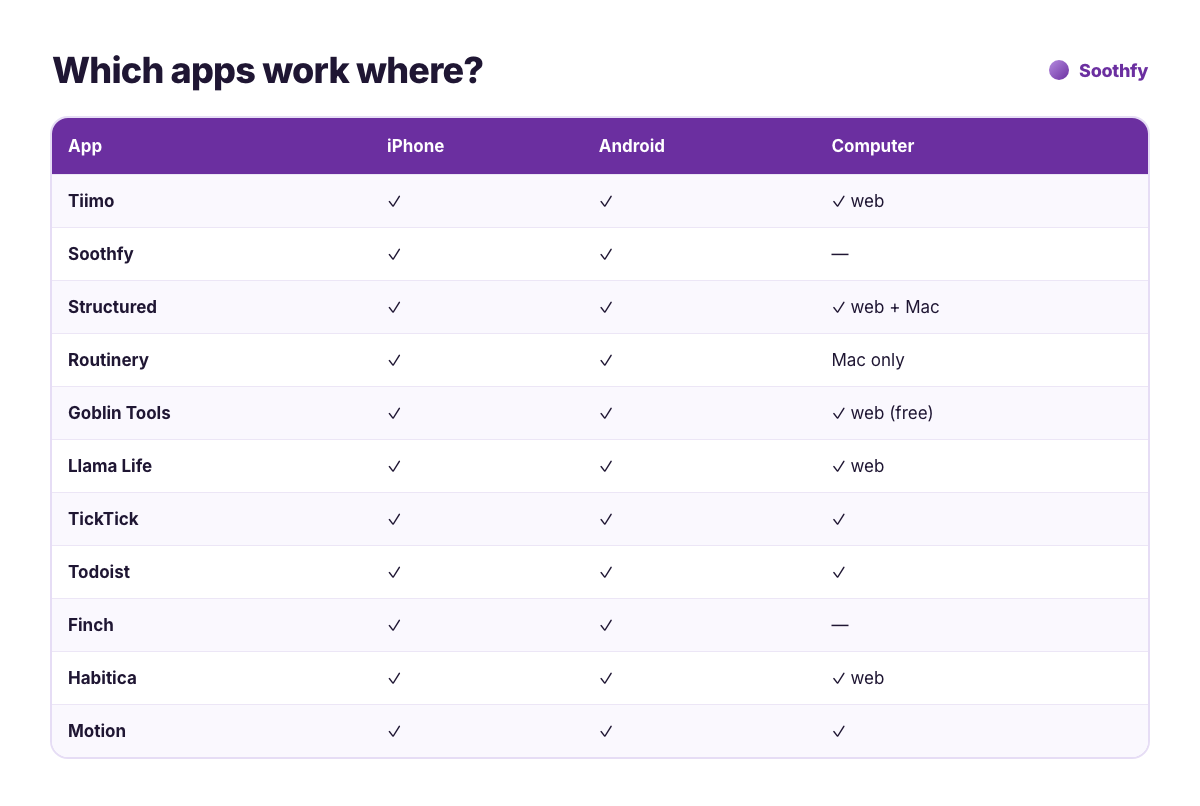
- Platforms: iPhone, Android and computer.
- Actively updated: every app below received an update in the past year.
- Clear best use: each app wins at one specific job.
We did not receive payment from any app listed. Soothfy is our own app; we've included it in one specific category and been clear about where other apps are the better choice.
Tiimo Alternatives Compared: Ratings, Prices and Platforms
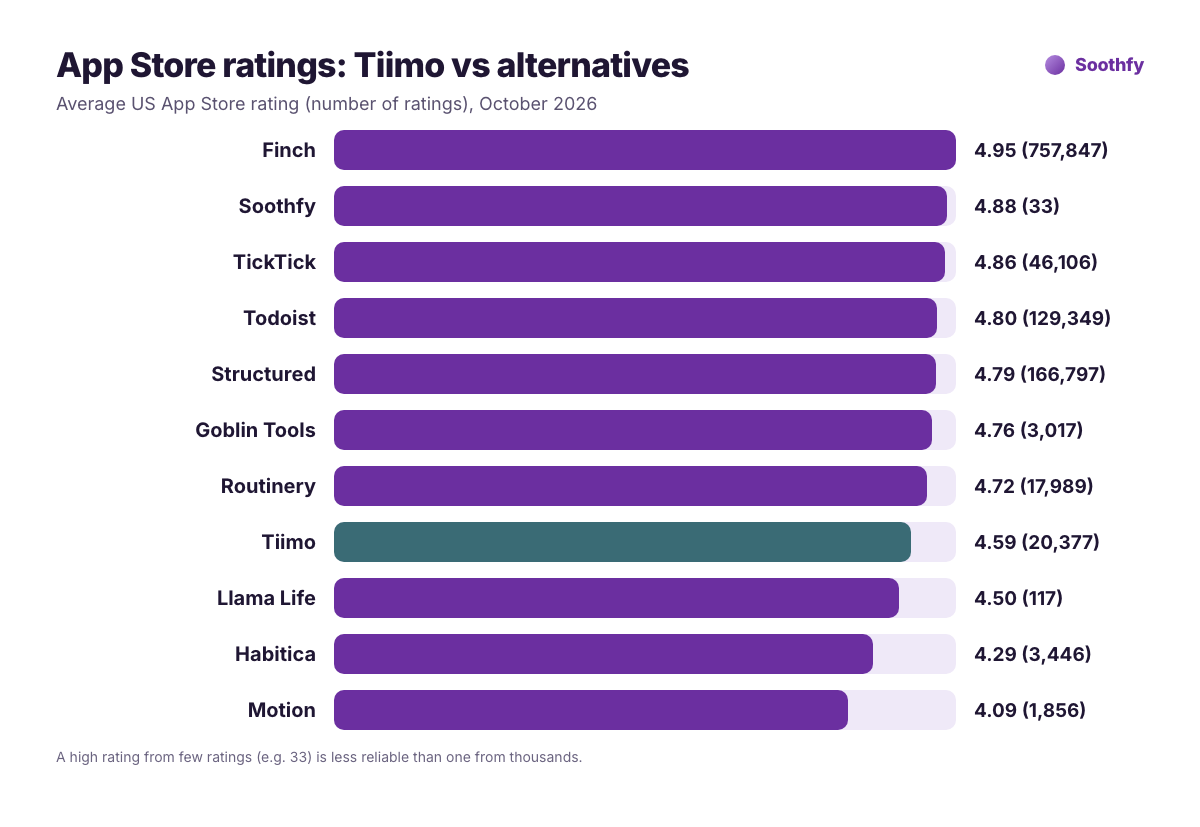
| App | Best for | App Store rating | Free version | Paid (US) |
|---|---|---|---|---|
| Tiimo (for reference) | Visual neurodivergent planning | 4.59 (20,377) | Yes, limited | ~$54–$80/yr |
| Soothfy | ADHD routines + mental health | 4.88 (33) | Free trial | $49.99/yr · $8.99/mo |
| Structured | Closest visual timeline | 4.79 (166,797) | Yes, strong | ~$29.99/yr |
| Routinery | Step-by-step routines | 4.72 (17,989) | Yes | ~$39.99/yr |
| Goblin Tools | Breaking down tasks | 4.76 (3,017) | Yes (website) | $1.99 one-time app |
| Llama Life | Time blindness timers | 4.50 (117) | 7-day trial | $39/yr · $6/mo |
| TickTick | Tasks + calendar + Pomodoro | 4.86 (46,106) | Yes | ~$35.99–$49.99/yr |
| Todoist | Fast task capture | 4.80 (129,349) | Yes | $60/yr · $7/mo |
| Finch | Gentle self-care | 4.95 (757,847) | Yes, generous | up to $69.99/yr |
| Habitica | Gamified motivation | 4.29 (3,446) | Full app free | Optional $47.99/yr |
| Motion | AI auto-scheduling | 4.09 (1,856) | Trial | $29/mo billed yearly |
Ratings: U.S. App Store, October 2026. Prices: public U.S. listings checked October 2026; they vary by country, store and promotions.
The 10 Best Tiimo Alternatives in 2026
1. Structured: Best Overall Tiimo Alternative (Closest Visual Timeline)
Free · Pro ~$29.99/yr · iPhone, Android, Mac, webIf what you love about Tiimo is seeing your day, Structured is the closest replacement. It turns your tasks and calendar events into a single, color-coded vertical timeline, so you can see what's now, what's next and how much time is left. It's one of the most popular planners on the App Store, with a 4.79★ average from 166,797 ratings.
Key features: visual timeline of your day · calendar import · recurring tasks · energy/timing per task · inbox for unscheduled tasks · widgets · web and Mac apps.
Pros: very close to Tiimo's core visual experience; strong free plan; works everywhere including the web; cheaper Pro.
Cons: less explicitly designed for neurodivergent users than Tiimo; no built-in support for emotional regulation or mood.
Best for: people who want Tiimo's visual day for less money, or need it on Android and the web. See also Structured app alternatives.
2. Soothfy: Best for ADHD Routines Plus Mental Health Support
Free trial · $49.99/yr or $8.99/mo · iPhone, AndroidMost Tiimo alternatives plan your tasks. Soothfy focuses on the habits underneath them, and on the stress, anxiety and low mood that often come with ADHD. After a short assessment, it builds a personalized 30-day plan around three daily anchor habits: one for your morning, one for work, one for your evening.
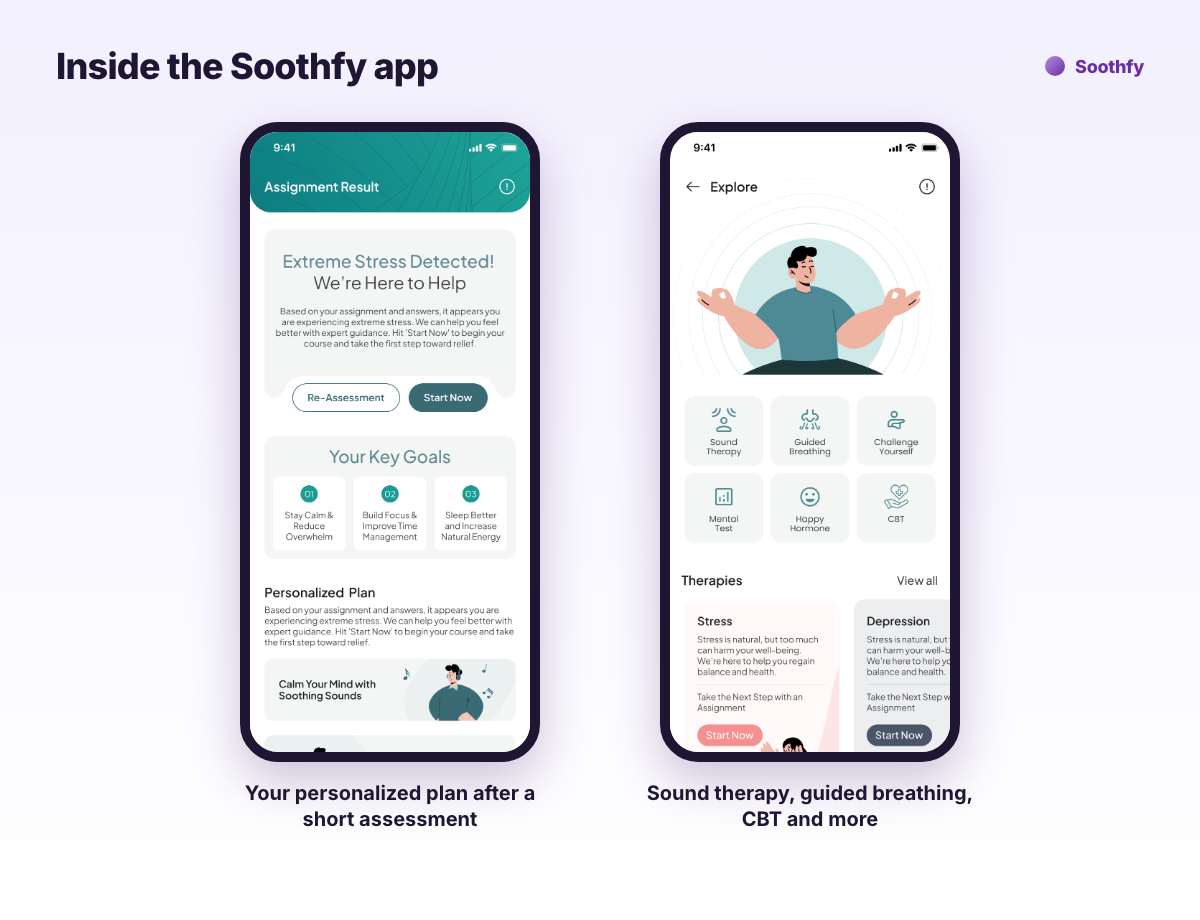
Key features: 3 daily anchor habits with streaks and a grace period · new short CBT-based activities each day · mood tracking and journaling · a daily Brain Score (0–100) · quick relief tools and sound therapy · check-ins on days 10, 20 and 30.
Pros: combines routines with emotional support; small, repeatable daily structure suits ADHD; one missed day doesn't reset progress.
Cons: not a visual calendar or full task manager, so pair it with Structured or TickTick if you need one; phone only; newer app with fewer ratings (4.88★ from 33).
Best for: people whose planning falls apart when they're stressed, anxious or low, and who want daily routines that stick.
Build ADHD routines that actually stick
Soothfy creates a personalized 30-day plan with three daily anchor habits, mood tracking and quick relief tools.
Try Soothfy Free3. Routinery: Best for Step-by-Step Morning and Evening Routines
Free · Premium ~$39.99/yr · iPhone, Android, MacRoutinery turns a routine into a guided sequence: "Brush teeth, 2 min" → "Get dressed, 5 min" → "Make coffee, 4 min", with a timer for each step. For ADHD brains that drift mid-routine, that one-step-at-a-time focus can be the difference between leaving on time and being 30 minutes late. 4.72★ from 17,989 ratings.
Pros: excellent for morning and bedtime routines; timers make time visible; large library of routine templates.
Cons: built for routines, not a full day planner or task list; no web version.
Best for: people who struggle most with getting through the same routines every day. Compare more options in Routinery alternatives, and see our ADHD morning routine guide.
4. Goblin Tools: Best Free Tiimo Alternative for Breaking Down Tasks
Free website · $1.99 one-time app · iPhone, Android, webGoblin Tools is a set of small AI tools built for neurodivergent people. Its best-known tool, Magic ToDo, takes a vague task like "clean the kitchen" and breaks it into small, concrete steps, with a "spiciness" level for how detailed you want it. The website is free with no account needed; the app is a one-time $1.99. 4.76★ from 3,017 ratings.
Pros: genuinely free on the web; no subscription; brilliant for task paralysis.
Cons: not a planner or calendar; no reminders or schedule.
Best for: anyone who freezes in front of big tasks. More on that in How to Break ADHD Task Paralysis in Under 5 Minutes.
5. Llama Life: Best for Time Blindness
7-day trial · $39/yr or $6/mo · iPhone, Android, webLlama Life gives every task on your list its own countdown timer, so you always see how long you've planned and how much is left. It's built around single-tasking: one task, one timer, then the next. It's one of the most direct answers to time blindness outside Tiimo. 4.50★ from 117 ratings.
Pros: makes time concrete for every task; playful, low-pressure design; works on the web.
Cons: no free plan after the trial; smaller user base.
Best for: people who underestimate how long things take. Learn more in What Is Time Blindness in ADHD?
6. TickTick: Best All-in-One Task Manager and Calendar
Free · Premium ~$35.99–$49.99/yr · iPhone, Android, computerIf you outgrew Tiimo because you have too many tasks across work and life, TickTick combines a to-do list, calendar views, a Pomodoro focus timer and a habit tracker in one app. 4.86★ from 46,106 ratings.
Pros: very complete; flexible recurring tasks; built-in focus timer and habits; generous free plan.
Cons: the number of features can overwhelm some ADHD users; less visual and calming than Tiimo.
Best for: people who want one app for everything and don't mind some setup.
7. Todoist: Best for Fast Task Capture
Free · Pro $60/yr or $7/mo · iPhone, Android, computerTodoist is famous for natural-language capture: type "Call dentist Tuesday 3pm" and it schedules it. That speed matters with ADHD, because the thought disappears if capturing it takes too long. 4.80★ from 129,349 ratings.
Pros: fastest capture of any app here; works everywhere; integrates with Outlook, Google Calendar and more.
Cons: a list, not a visual day; the free plan limits projects; Pro price rose to $5/month (billed yearly) in late 2025.
Best for: people who mainly need to get tasks out of their head reliably.
8. Finch: Best for Gentle, Gamified Self-Care
Free · Finch Plus up to $69.99/yr · iPhone, AndroidFinch turns small self-care goals into caring for a virtual pet bird. It's not a planner, but for people whose real problem is motivation and self-kindness rather than scheduling, it's one of the most loved apps on the App Store: 4.95★ from 757,847 ratings.
Pros: very gentle and encouraging; generous free version; great for tiny wins on hard days.
Cons: no visual schedule or time management; light on evidence-based techniques.
Best for: people who need encouragement more than structure. See Finch app alternatives.
9. Habitica: Best Free Gamified Option
Free · optional subscription $47.99/yr · iPhone, Android, webHabitica turns your habits, dailies and to-dos into a role-playing game: complete tasks to level up your character, skip them and you lose health. The whole app is free; the subscription is cosmetic. 4.29★ from 3,446 ratings.
Pros: fully free; novelty and rewards suit dopamine-seeking ADHD brains; party features add accountability.
Cons: the game can become the distraction; not visual or calm like Tiimo.
Best for: people who are motivated by games and streaks.
10. Motion: Best for AI Auto-Scheduling (If Your Calendar Is Packed)
$29/mo billed yearly ($49 monthly) · iPhone, Android, computerMotion automatically fits your tasks into the gaps in your calendar and reshuffles them when plans change. For busy professionals with ADHD, removing the "where do I fit this?" decision can be a relief. 4.09★ from 1,856 ratings.
Pros: powerful automatic scheduling; strong calendar integrations.
Cons: by far the most expensive option here (about $348/year); built for work rather than daily life; the iPhone app was last updated in November 2025.
Best for: professionals with complex work calendars who will use it every day. For more work-focused options, see Notion alternatives for ADHD.
Which Tiimo Alternative Is Right for You?
The best app depends on why Tiimo isn't working for you. Start with your biggest struggle:
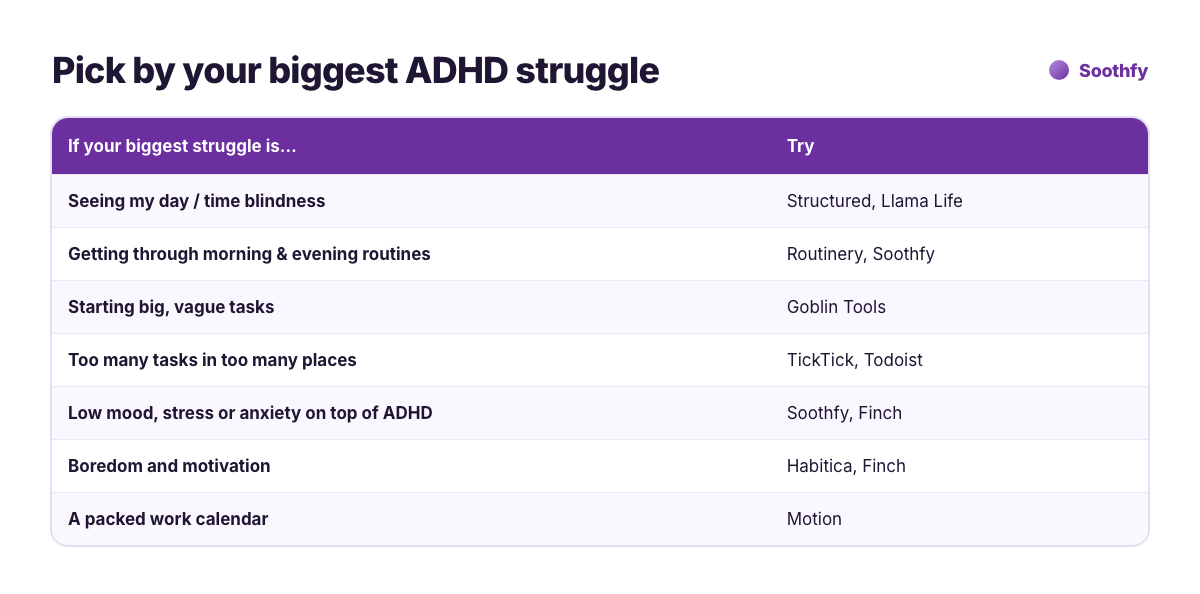
| If you left Tiimo because… | Try |
|---|---|
| It's too expensive | Structured (~$30/yr), Goblin Tools (free web), Habitica (free) |
| Calendar sync didn't work with Outlook/Google | Todoist, TickTick, Motion |
| You need flexible repeating tasks and reminders | TickTick, Todoist |
| You didn't want an AI assistant | Structured, Routinery, Llama Life |
| You need it on Android or your computer | Structured, TickTick, Todoist |
| Planning collapses when you're stressed or low | Soothfy, Finch |
Is There a Free Tiimo Alternative?
Yes. If you want to avoid another subscription, these have genuinely useful free versions:
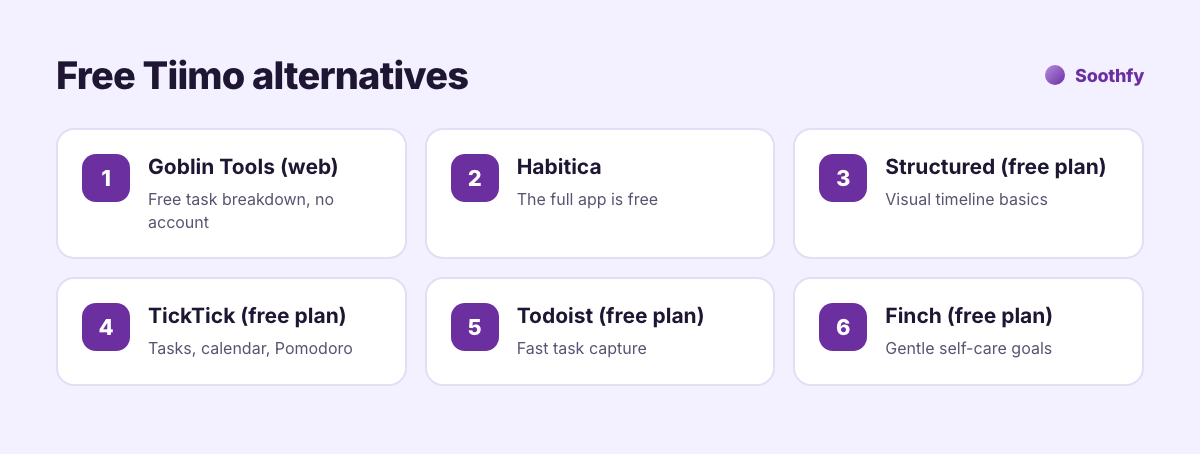
- Goblin Tools (website): free task breakdown, no account needed.
- Habitica: the full app is free; the subscription is cosmetic.
- Structured (free plan): the visual timeline basics.
- TickTick and Todoist (free plans): solid task management with limits.
- Finch (free plan): gentle self-care goals.
How to Switch From Tiimo Without Losing Your Routines
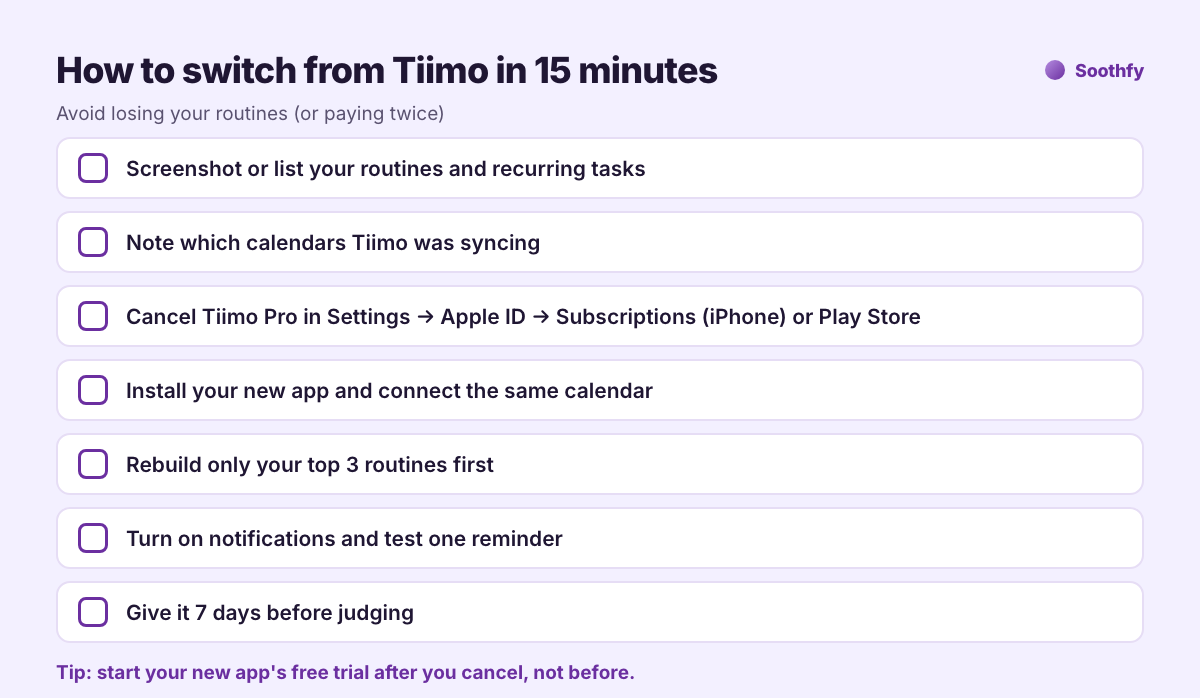
- Screenshot or write down your routines and recurring tasks.
- Note which calendars Tiimo was syncing.
- Cancel Tiimo Pro: on iPhone go to Settings → [your name] → Subscriptions; on Android use the Play Store → Payments & subscriptions. Deleting the app does not cancel a subscription.
- Install your new app and connect the same calendar.
- Rebuild only your top 3 routines first. Rebuilding everything on day one is a classic ADHD overwhelm trap.
- Turn on notifications and test one reminder.
- Give it 7 days before deciding.
If routines are your main goal, our ADHD daily routine guide shows how to build one that survives bad days. And if your days often feel foggy no matter which app you use, read ADHD Brain Fog: 9 Ways to Clear It.
Key Facts: Tiimo Alternatives in 2026
- Tiimo has a 4.59★ average from 20,377 U.S. App Store ratings and was Apple's iPhone App of the Year 2025.
- Of Tiimo's 100 most recent U.S. App Store reviews (Dec 2025–Aug 2026), 49 were 3★ or lower; the most common themes were missing features, AI-focused changes, bugs/sync and price.
- Structured is the closest visual alternative (4.79★ from 166,797 ratings), with Pro around $30/year.
- Goblin Tools is free on the web and $1.99 one-time as an app.
- Motion is the most expensive alternative listed, at about $348/year billed yearly.
Final Verdict
If you want the closest thing to Tiimo for less, choose Structured. If routines are your battle, choose Routinery. If you freeze in front of big tasks, use Goblin Tools for free. If time slips away, try Llama Life. If you need everything in one place, pick TickTick or Todoist. And if your plans fall apart when stress, anxiety or low mood hit, Soothfy builds the daily habits underneath your schedule. It also pairs well with any planner above.
For a wider look at ADHD tools, see Best ADHD Apps in 2026 and Fabulous app alternatives.
Frequently Asked Questions
Sources
- Apple App Store (US): Tiimo, Structured, Routinery, Goblin Tools, Llama Life, TickTick, Todoist, Finch, Habitica, Motion, Soothfy. Ratings and listings checked October 2026.
- Daring Fireball. 2025 App Store Award Winners: Tiimo, Essayist, and Detail.
- Structured. Structured Web 1.0 and Why Structured is moving to subscriptions.
- Pricing references (October 2026): Tiimo pricing, Llama Life, TickTick, Todoist, Motion, Finch, Habitica.
- Review analysis: 100 most recent U.S. App Store customer reviews of Tiimo, December 2025 to August 2026, grouped by theme by Soothfy.
Ratings, prices and features change often. We'll update this comparison regularly. Last updated October 1, 2026.