Best Apps for Health Anxiety: 7 Apps That Help in 2026
By Soothfy Team ·
Googling symptoms at 2 a.m. and fearing the worst? Here are the best apps for health anxiety in 2026 and who each one is for.
A twinge in your chest, a headache that won't quit, a mole that looks different. Within minutes you're searching symptoms, reading worst-case stories and feeling your heart race, which then feels like another symptom. You know you've been checked before, but the relief never lasts.
That's health anxiety, sometimes called illness anxiety or hypochondria, and it's far more common than people realize. It isn't about imagining things. Your body sensations are real; it's the fear and the checking that keep the cycle going. The good news is that cognitive behavioral therapy (CBT) works very well for health anxiety, and apps can help you practise its skills every day.
In this guide we compare the 7 best apps for health anxiety in 2026: what each one does, how it helps break the worry-and-check cycle, what it costs and who it's for.
Quick guide: the best apps for health anxiety in 2026
- 🥇 Soothfy: best overall, with 2-minute CBT exercises for symptom fear, mood and sleep tracking and a daily plan
- Dare: best audio program with dedicated health anxiety help
- MindShift CBT: best free CBT toolkit
- Clarity: best CBT journal for catastrophic thoughts
- Wysa: best AI chatbot for late-night worries
- How We Feel: best free app for understanding emotions
- Headspace: best mindfulness for body sensations
How We Chose These Health Anxiety Apps
To build this list, we compared each app's U.S. App Store listing, features and current prices, and read App Store reviews from people who use them for anxiety, including health worries. We favored apps that help you respond differently to body sensations and worrying thoughts, rather than ones that offer more ways to check symptoms, which can make health anxiety worse.
Soothfy is our app. Where another app is the better pick for a need, we say so. These apps are not a substitute for medical care: if you have new or worrying symptoms, see a doctor.
- CBT-based tools, the approach with the strongest evidence for health anxiety
- Help with symptom fear in the moment
- Tools to reduce checking and reassurance-seeking
- Clear pricing: real U.S. App Store prices, October 2026
- Actively updated in 2026
What Are the Best Apps for Health Anxiety?
Health anxiety is kept going by a cycle: you notice a sensation, interpret it as a sign of serious illness, feel anxious, and then check, search or seek reassurance, which brings short-term relief but makes the next worry stronger. The best apps help you break that cycle. They calm the physical anxiety that feels like more symptoms, help you question catastrophic thoughts and support you in delaying or dropping the checking habit. Here's how they compare at a glance.
Best Apps for Health Anxiety Compared
| App | Best for | Price (U.S.) |
|---|---|---|
| 🥇 Soothfy | CBT relief for symptom fear + tracking + plan | Free download · 7-day trial · $49.99/yr |
| Dare | Health anxiety audio program | Free · from $9.99/mo |
| MindShift CBT | Free CBT toolkit | Free |
| Clarity | CBT thought journal | Free · Pro Mode up to $69.99 |
| Wysa | AI chatbot for worries | Free basics · Premium $74.99/yr |
| How We Feel | Understanding emotions | Free |
| Headspace | Mindfulness of sensations | $12.99/mo or $69.99/yr |
Prices: U.S. App Store listings, October 2026. They vary by country, plan and offer.
The 7 Best Apps for Health Anxiety in 2026
1. Soothfy: Best Overall for Health Anxiety


Soothfy is a mental health app for anxiety, stress, OCD, depression, ADHD and more, with tools that fit the health anxiety cycle. When a sensation sets off a wave of fear, instead of searching symptoms, open Instant Relief, tap what you're feeling, like a racing heart, chest tightness or catastrophic thoughts, and get 3 CBT exercises with a 2-minute timer. They help calm your body, question the worst-case story and ride out the urge to check. Mood and sleep tracking, a journal and a personalized 30-day plan help you see patterns and build confidence over time.
Key features
- Instant Relief: 35 symptoms, each with 3 CBT exercises and a 2-minute timer, so you have something to do other than searching or checking.
- Learns what works: rate each exercise, and Soothfy shows your most helpful tools first next time.
- Mood and sleep tracker: notice how stress and poor sleep raise health worries, with reports you can share with your doctor or therapist.
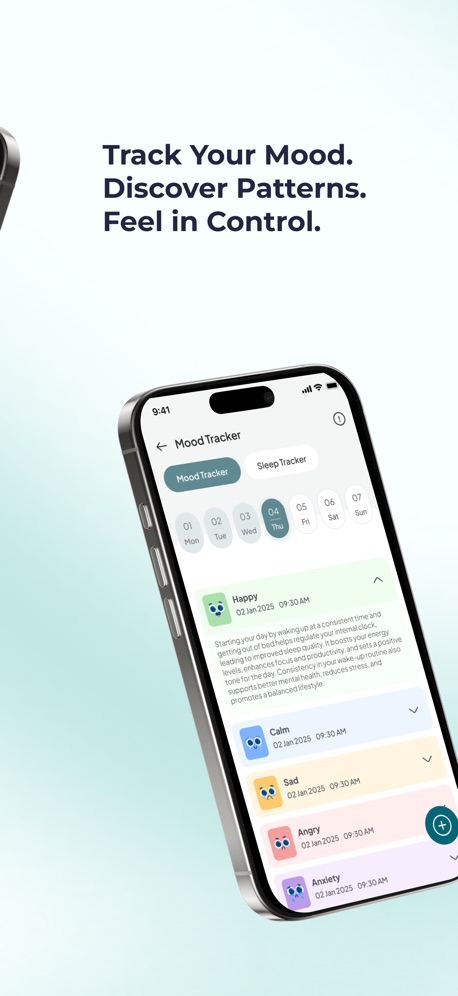
- Journal: write or record a voice note about the worry instead of searching it.
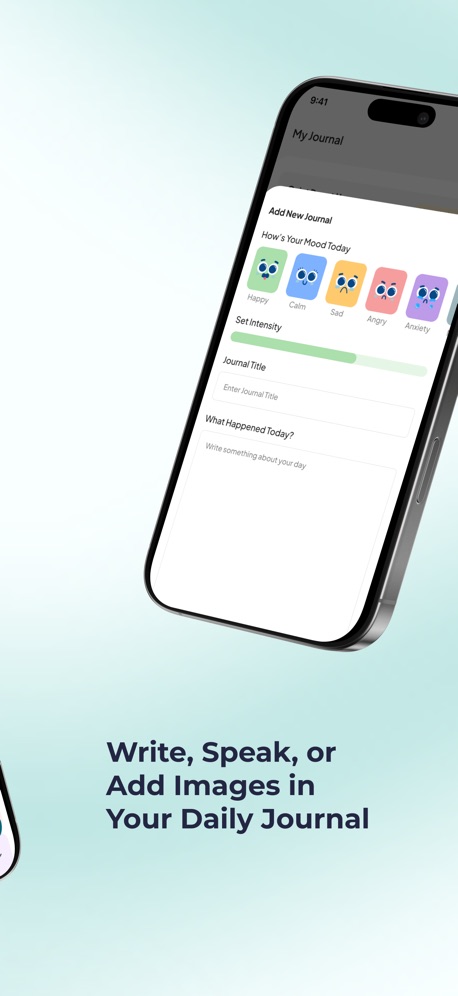
- Personalized 30-day plan: small daily steps that build calm and reduce avoidance, adapted to your mood and energy.

- One subscription for 9 conditions, including anxiety and OCD, plus sound therapy, a CBT library and a moderated community.
Pros
- A healthier response to symptom fear than searching
- CBT is the most effective approach for health anxiety
- Tracks the stress and sleep patterns behind worries
- Clear 7-day free trial, then $49.99/year
Cons
- No in-app therapist, so pair it with professional care if health anxiety is severe or long-lasting
Pricing
- Free to download with a 7-day free trial
- $49.99/year or $8.99/month (U.S.)
Suitable for
- People who search symptoms or check their body repeatedly
- Anyone whose physical anxiety feels like illness
- People who want to build calm and confidence over time
How to start
- Download Soothfy free on iPhone or Android.
- Take the 2-minute assessment.
- Next time you feel the urge to search a symptom, open Instant Relief first and try one exercise.
What users say
"Gets rid of stress that I've been having and gets me very relaxed. I definitely recommend it!"
App Store review (U.S.)
Break the worry-and-check cycle
CBT relief for symptom fear, mood tracking and a daily plan. Free for 7 days.
Free to download · 7-day free trial


2. Dare: Best Audio Program With Health Anxiety Help

Dare is an anxiety and panic app based on the best-selling book DARE by Barry McDonagh, and it lists health concerns and visiting the doctor among the situations it covers. Its method teaches you to stop fighting anxious sensations and allow them to pass, which is especially useful for health anxiety, where fearing a sensation makes it feel stronger. It includes rapid-relief audios, situation audios, a training program, help with intrusive thoughts and a mood journal.
Compared with general apps, Dare speaks directly to the physical side of health anxiety. Many reviewers say they believed something was medically wrong because of their symptoms until they learned it was anxiety, and that Barry's calm guidance helped. It's mostly audio and more focused on panic than on reassurance-seeking. Subscriptions are listed in the U.S. App Store from $9.99 to $12.99 a month and $59.99 to $69.99 a year (October 2026).
Our take: choose Dare if your health anxiety comes with strong physical symptoms and panic.
Key features
- Rapid-relief audios
- Situation audios, including doctor visits
- DARE method training
- Help with intrusive thoughts
- Mood journal

Pros
- Directly addresses fear of sensations
- Calm, practical guidance
- Strong for panic-like symptoms

Cons
- Mostly audio
- Less focus on checking habits
- Several prices listed
Pricing
- Free with limited content
- Subscriptions from $9.99/month; yearly $59.99–69.99 (U.S. App Store, several prices listed)
Suitable for
- People with health anxiety and panic symptoms
How to start
- Download Dare and listen to its health anxiety audio the next time a sensation worries you.
What users say
"I truly believed so had something medically wrong with me because of all the physical symptoms"
App Store review (U.S.)
3. MindShift CBT: Best Free CBT Toolkit

MindShift CBT is a free anxiety app from Anxiety Canada, built on cognitive behavioral therapy. Its thought journal helps you challenge catastrophic health thoughts, like "this headache must be a tumor," and its fear ladder lets you gradually face things you avoid, such as reading about health, visiting a doctor or not checking your pulse. It also has guided relaxation, mindfulness and a community forum.
Compared with paid apps, MindShift gives you the core CBT tools for health anxiety for free, with no in-app purchases. The fear ladder can be used for exposure and response prevention, slowly reducing checking and reassurance-seeking, which is one of the most effective parts of treatment. It feels like a workbook, so you'll get more from it if you use it regularly or alongside a therapist.
Our take: choose MindShift CBT if you want free, proven CBT tools to work on health worries.
Key features
- Thought journal for catastrophic thoughts
- Fear ladder for gradual exposure
- Guided relaxation
- Mindfulness meditations
- Community forum

Pros
- Completely free
- Includes exposure tools
- Made by an anxiety nonprofit

Cons
- Feels like a workbook
- Less quick help in the moment
- Basic tracking
Pricing
- Free (no in-app purchases)
Suitable for
- People ready to work on health worries with CBT
How to start
- Download MindShift CBT and write one health worry in the thought journal, then look for the evidence for and against it.
What users say
"This app claims to be a CBT centered app for anxiety disorders and I think that claim is pretty true to the content."
App Store review (U.S.)
4. Clarity: Best CBT Journal for Catastrophic Thoughts

Clarity is a CBT self-help journal that helps you catch and change the thinking patterns behind anxiety. For health anxiety, its distortion spotting is especially useful: catastrophizing ("it's cancer"), probability overestimation ("this is likely serious") and emotional reasoning ("I feel scared, so something must be wrong"). Guided thought records walk you to a more balanced view, and it also has AI-assisted journaling, a chatbot and a mood tracker.
Compared with in-the-moment tools, Clarity is best after a worry spike, when you can sit with the thought and test it. Writing it down instead of searching it is itself a helpful habit change. Reviewers with OCD and anxiety say it helped when therapy was hard to access. Pro Mode is listed at several prices in the U.S. App Store, mostly $59.99 to $69.99 a year (October 2026).
Our take: choose Clarity if writing out and testing your health worries helps you calm down.
Key features
- CBT thought records
- Distortion spotting
- AI-assisted journaling and chat
- Mood tracker
- Coping skills

Pros
- Great for catastrophic thinking
- Replaces searching with writing
- Clear CBT structure

Cons
- Less help mid-panic
- Pro needed for many features
- Several prices listed
Pricing
- Free with limited features
- Pro Mode listed at several prices, mostly $59.99–69.99/year (U.S. App Store)
Suitable for
- People who catastrophize about symptoms
How to start
- Download Clarity and complete one thought record the next time a symptom worries you.
What users say
"For a while, I have struggled with OCD and anxiety."
App Store review (U.S.)
5. Wysa: Best AI Chatbot for Late-Night Worries

Wysa is an AI mental health chatbot, shown as a friendly penguin, with techniques inspired by CBT and DBT. When a health worry hits at night, you can type it out, and Wysa asks questions, reflects back and suggests techniques like observing thoughts, deep breathing or grounding. It's anonymous and available any time.
Compared with symptom-checker apps and search engines, Wysa redirects you from the content of the worry to how you're coping with it, which is a healthier habit. The caution: using any chatbot to repeatedly ask whether you're okay can turn into reassurance-seeking, which keeps health anxiety going. Premium is listed at $74.99 a year or $19.99 a month in the U.S. App Store, with paid human support from $29.99 a week (October 2026).
Our take: choose Wysa if talking through a worry helps you settle, and use it for coping, not for checking symptoms. See our Soothfy vs Wysa comparison.
Key features
- AI chatbot for worries
- Techniques for observing thoughts
- CBT and DBT-inspired tools
- Anonymous use
- Optional paid human support

Pros
- Available at night
- No judgment
- Shifts focus to coping

Cons
- Can become reassurance-seeking
- Replies can feel repetitive
- Premium is pricey
Pricing
- Free chatbot basics
- Premium $74.99/year or $19.99/month; guided support from $29.99/week (U.S. App Store)
Suitable for
- People whose health worries peak at night
How to start
- Download Wysa and ask for a grounding exercise the next time a worry wakes you.
What users say
"There are certain situations that can get me running on high anxiety"
App Store review (U.S.)
6. How We Feel: Best Free App for Understanding Your Emotions
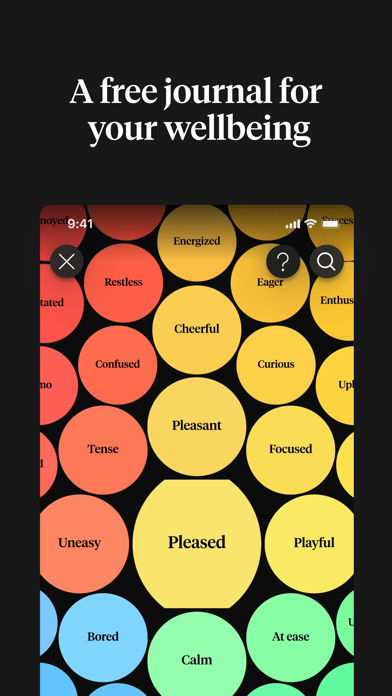
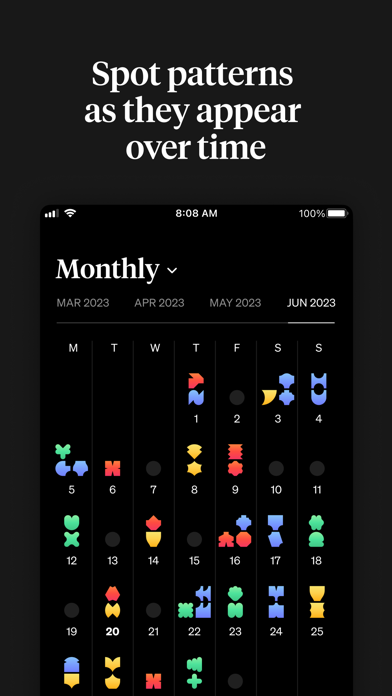
How We Feel is a free app from a science-based nonprofit, created with Yale's Center for Emotional Intelligence and based on the work of Dr. Marc Brackett. You check in by choosing from dozens of specific emotions, like worried, scared or uneasy, and get short strategies for how you feel. It can show patterns with sleep and exercise data from Apple Health.
Compared with CBT apps, How We Feel is gentler. For health anxiety, it helps you notice that a spike in fear often follows stress, poor sleep or a busy week, rather than a real change in your health. It doesn't include exposure tools or a health anxiety program. A caution for some users: if looking at health data makes you anxious, you may prefer to keep Apple Health integration turned off.
Our take: choose How We Feel if you want a free, private way to understand the emotions behind your health worries.
Key features
- Dozens of specific emotions
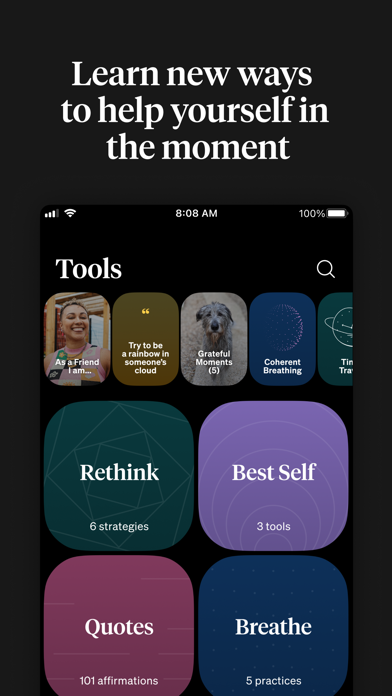
- Short strategies for each feeling
- Patterns with sleep and exercise
- Apple Health integration (optional)
- On-device data by default
Pros
- Completely free
- Strong privacy
- Helps link worries to stress and sleep
Cons
- No health anxiety program
- Not for peak panic
- Health data may trigger some users
Pricing
- Free (nonprofit)
Suitable for
- People who want to understand emotional patterns
How to start
- Download How We Feel and check in each evening for a week to spot patterns.
What users say
"I've tried a lot of mental health apps over the years"
App Store review (U.S.)
7. Headspace: Best Mindfulness for Body Sensations
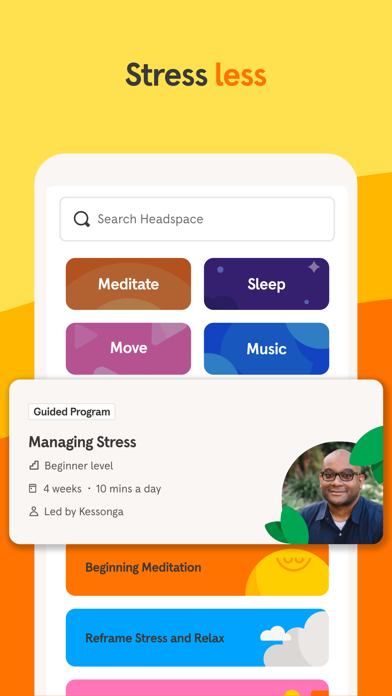
Headspace offers 500+ guided meditations, courses on anxiety and stress, body scans, sleep content and focus music, plus coaching, therapy or Ebb, its AI companion, in some plans and regions.
Compared with CBT apps, Headspace helps health anxiety in a different way. Mindfulness practices, like body scans, teach you to notice sensations with curiosity instead of alarm, which over time can make a twinge feel like just a twinge. Some people with health anxiety find body-focused practices uncomfortable at first, so start with breath-focused sessions and build up. It's listed at $12.99 a month or $69.99 a year in the U.S. App Store, with Headspace Plus at $94.99 (October 2026).
Our take: choose Headspace if you want to change your relationship with body sensations over time. See our honest Headspace review.
Key features
- 500+ guided meditations
- Body scans
- Anxiety and stress courses
- Sleep content
- Coaching and therapy in some plans

Pros
- Builds a calmer relationship with sensations
- Beginner-friendly
- Polished content

Cons
- Body scans can feel hard at first
- Needs regular practice
- Subscription required
Pricing
- $12.99/month or $69.99/year; Headspace Plus $94.99 (U.S. App Store)
Suitable for
- People who want long-term calm around body sensations
How to start
- Download Headspace and start with a breath-focused session before trying a body scan.
What users say
"When I am suffering from stress, health anxiety, or fibro/stress related body pains I turn to this app"
App Store review (U.S.)
Final Thoughts
Health anxiety can take over your days and nights, but it responds very well to CBT skills, and the right app can help you practise them instead of searching symptoms. Soothfy is our top pick: 2-minute CBT exercises for symptom fear, mood and sleep tracking and a daily plan. For an audio program with health anxiety help, choose Dare. For free CBT and exposure, MindShift CBT. To test catastrophic thoughts, Clarity. For late-night worries, Wysa. To understand your emotions, How We Feel, and to build calm around sensations, Headspace.
Always see a doctor about new, persistent or worsening symptoms. If health anxiety is taking up hours of your day, ask your doctor about CBT for health anxiety, which is highly effective.
More guides: Best Apps for Panic Attacks, Best Apps for Overthinking, Best Apps for Social Anxiety, Best Apps for Test Anxiety, How to Stop an Anxiety Spiral in 2 Minutes, Soothfy vs Wysa, Best Anxiety Relief Apps and ADHD and Anxiety Statistics.
Try Soothfy free for 7 days
CBT relief for symptom fear in 2 minutes.
Free to download · 7-day free trial
Best Apps for Health Anxiety: FAQs (2026)
1. What is the best app for health anxiety?
Soothfy is our top pick, with 3 CBT exercises for symptoms like a racing heart or catastrophic thoughts and a 2-minute timer, plus mood and sleep tracking and a daily plan. Dare has dedicated health anxiety audio, and MindShift CBT is the best free option.
2. What is health anxiety?
Health anxiety, also called illness anxiety, is persistent worry about having or developing a serious illness, often despite reassurance from doctors. It usually involves noticing body sensations, interpreting them as dangerous, and then checking, searching or seeking reassurance. It's common, affects people of all ages and can come and go with stress.
3. Is health anxiety the same as hypochondria?
Hypochondria is an older term. Today, clinicians usually talk about health anxiety or illness anxiety disorder, and somatic symptom disorder when physical symptoms are a major focus. The experience and the treatment, mainly CBT, are similar. Many people prefer the term health anxiety because it feels less judgmental.
4. Why does searching symptoms make me feel worse?
Searching often brings up rare and frightening possibilities, which increases fear. Even when it brings relief, it teaches your brain that checking is needed to feel safe, so the next worry feels stronger. Reducing searching is a key part of recovery.
5. How do I stop checking my body?
Start by noticing how often you check, then gradually delay it, for example by waiting 15 minutes before checking, and reduce it over time. Use that time for a calming exercise instead. This is a form of exposure and response prevention, a core CBT technique.
6. Does CBT work for health anxiety?
Yes. CBT is the most effective treatment for health anxiety. It helps you test catastrophic thoughts, reduce checking and reassurance-seeking, and become less afraid of normal body sensations. Many people improve a lot within a few months.
7. Can anxiety cause physical symptoms?
Yes. Anxiety can cause a racing heart, chest tightness, dizziness, tingling, headaches, stomach upset and muscle tension. These symptoms are real, but they're caused by the body's stress response, and fearing them can make them stronger. Learning this is often the first big step toward feeling less afraid of them.
8. Should I still see a doctor if I have health anxiety?
Yes. Always see a doctor about new, persistent or worsening symptoms. It can help to agree on a plan with your doctor, like regular scheduled check-ups, so you don't need to seek reassurance between visits.
9. Can an AI chatbot help with health anxiety?
An AI chatbot like Wysa can help you cope with a worry and use calming techniques. But asking an AI repeatedly whether a symptom is serious is a form of reassurance-seeking, which can keep health anxiety going. Use it for coping skills, not for diagnosing.
10. Is health anxiety linked to OCD?
Health anxiety and OCD share features like intrusive thoughts and checking, and some people have both. Treatment for both often uses exposure and response prevention. Soothfy covers anxiety and OCD in one subscription.
11. Can sleep and stress make health anxiety worse?
Yes. Poor sleep and high stress make body sensations more noticeable and worries feel bigger. Soothfy tracks mood and sleep together, so you can see how they affect your health worries.
12. Are there free apps for health anxiety?
Yes. MindShift CBT and How We Feel are completely free. Dare, Clarity and Wysa have free versions with limited features, and Soothfy has a 7-day free trial. Pick one app and use it consistently rather than switching between many.
13. Should I use symptom tracking apps if I have health anxiety?
Be careful. For some people, tracking heart rate, blood pressure or symptoms becomes another form of checking that increases anxiety. If you notice that, talk to your doctor about what you actually need to monitor, and consider turning off notifications.
14. When should I get professional help for health anxiety?
Talk to a doctor or therapist if health worries take up a lot of your day, affect your work or relationships, or keep returning despite reassurance. CBT for health anxiety is very effective. In a crisis in the U.S., call or text 988.
Ready to worry less about your health?
Download Soothfy free and try Instant Relief the next time a symptom worries you.
Free to download · 7-day free trial
This article is for information only and is not medical advice. Prices and features change often. Last updated October 28, 2026.